Disclaimer: Devoted Grandma is reader-supported. If you purchase anything through my site, I may receive a small commission (at no cost to you). Thank you.
“I’m bored” can arrive five minutes after a grandchild walks through the door. It can also appear during a video call, in a waiting room, or just when Grandma thought everyone was happily settled.
You do not need a closet full of games to answer it. The best choice may be a tiny game that begins with one sentence and ends before either player gets tired of it.
Offer one or two possibilities, then let your grandchild choose. A child who declines is not rejecting you. They may need quiet, food, rest, or time to decide what sounds fun.
Choose a game by mood and time
- Quiet and quick: Try Fortunately, Unfortunately or The Last-Letter Game.
- Silly and quick: Try Wrong Answers Only or Mirror Me.
- Thoughtful and unhurried: Try Three Clues or Build a Dream Day.
- Energetic: Try Slow-Motion Challenge or Find It First.
- Not sure yet: Start with Five-Second Categories. You will know quickly whether to continue.
You can say, “Would you like something quiet, silly, or active?” That small choice gives your grandchild some control. It also avoids turning play into another demand. This same gentle approach matters throughout a visit. These ideas for taking pressure off grandkids during visits can help.
1. Fortunately, Unfortunately
First move: Say, “Fortunately, we found a treasure map.” Your grandchild adds a problem beginning with “Unfortunately.” Keep alternating between good luck and trouble.
Adapt it: Young children can use one short sentence. Older grandkids can make the twists clever, dramatic, or absurd. It works well in person or on a video call.
Stop gracefully: After six or eight turns, say, “Let’s give our story one final fortunate ending.”
2. Three Clues
First move: Think of an animal, object, person, or place and say, “I’m thinking of something. Your first clue is that it is smaller than a toaster.”
Adapt it: Give younger children concrete clues about color, sound, or location. Let older grandkids choose harder subjects, such as a movie character or historical figure. This is easy by phone or video.
Stop gracefully: Agree that each player gets three mystery rounds.
3. Wrong Answers Only
First move: Point to an ordinary object and ask, “What is this definitely not used for?” A spoon might become a tiny canoe paddle.
Adapt it: Keep the ideas simple for young children. With older grandkids, choose objects visible on the video screen and reward the funniest explanation.
Stop gracefully: Choose a “most wonderfully wrong” answer after five objects.
4. The Last-Letter Game
First move: Say an easy word, such as “cat.” The next player must say a word beginning with its last letter, such as “tree.”
Adapt it: Let younger players use any word and offer hints. Older players can stay within a category, such as foods or places. It works anywhere you can hear each other.
Stop gracefully: Set a goal of ten connected words, then celebrate reaching the chain’s end.
5. Five-Second Categories
First move: Say, “Name three things that are yellow.” Count slowly to five while your grandchild answers, then switch roles.
Adapt it: Give young children familiar categories and a generous count. Invite older grandkids to invent oddly specific ones, such as “things you would not want in your backpack.”
Stop gracefully: Play five categories or stop as soon as choosing them becomes harder than answering them.
6. Mirror Me
First move: Face each other and say, “Copy me as closely as you can.” Slowly lift a hand, tilt your head, or make a gentle expression.
Adapt it: Younger children may enjoy obvious movements. Older grandkids can create slow, complicated sequences. On video, keep movements within the camera frame.
Stop gracefully: Give each person two turns as leader, then finish with a matching bow.
7. Build a Dream Day
First move: Ask, “If we could plan one make-believe day with no travel limits, where would breakfast be?” Take turns adding each part.
Adapt it: Offer young children two choices when they get stuck. Older grandkids can add a budget, theme, or surprising rule. Phone and video versions work naturally.
Stop gracefully: End when you reach bedtime, then each name the part you would most enjoy.
8. Slow-Motion Challenge
First move: Say, “Can you cross the room in the silliest slow motion possible?” Make sure the path is clear first.
Adapt it: Young children can pretend to move like an animal. Older grandkids can act out a slow-motion sport or movie scene. On video, use movements that stay safely in place.
Stop gracefully: Take three short turns each, then hold a final frozen pose.
9. Find It First
First move: Say, “Find something soft and bring it back, or point to it.” Both players search within an agreed safe area.
Adapt it: Use colors and textures for younger children. Give older grandkids clues such as “something useful that has no buttons.” It is especially good on video because each player searches a different room.
Stop gracefully: Decide on five finds before starting. No racing on stairs or opening private drawers.
10. One-Line Drawing
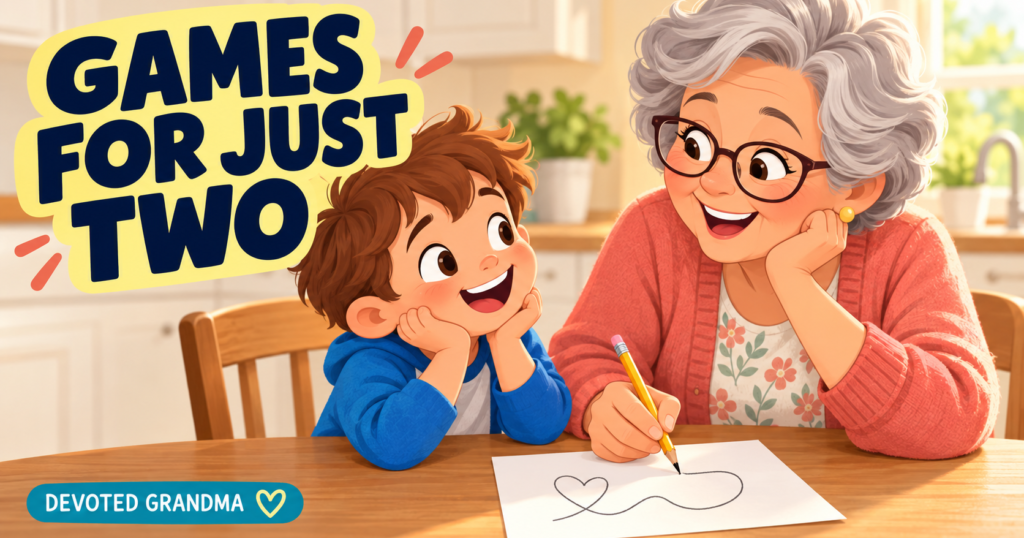
First move: With any pencil and scrap paper already nearby, say, “Let’s draw something without lifting the pencil.” Choose a face, animal, or mystery creature.
Adapt it: Young children can scribble first and decide what the shape resembles. Older grandkids can draw the same subject and compare results. On video, hold finished drawings up to the camera.
Stop gracefully: Make two drawings each, then give every picture a playful title.
11. Add One Detail
First move: Begin with, “I opened the kitchen door and saw a penguin.” Your grandchild repeats the sentence and adds one detail. Keep taking turns, repeating and extending the scene.
Adapt it: Let younger children retell only the newest details. Older grandkids can try to remember the entire growing story. It works in person, by phone, or on video.
Stop gracefully: Set a limit of ten details, or end earlier with, “And that is when Grandma woke up.”
Keep the invitation light
A game does not have to fill the afternoon to be worthwhile. Three cheerful minutes can change the feeling of a quiet stretch without creating a large production.
If your grandchild wants to keep going, wonderful. If they lose interest, use the stopping point and let the game end warmly. You might say, “That was fun. We can play again another time.”
For a grandchild who lives far away, small shared moments can work better than expecting a long conversation. These gentle ways to share the after-school hour from a distance offer more low-pressure ideas.
The aim is not to defeat boredom every time. It is to make a simple opening for connection, one that just two people can enjoy.