Disclaimer: Devoted Grandma is reader-supported. If you purchase anything through my site, I may receive a small commission (at no cost to you). Thank you.
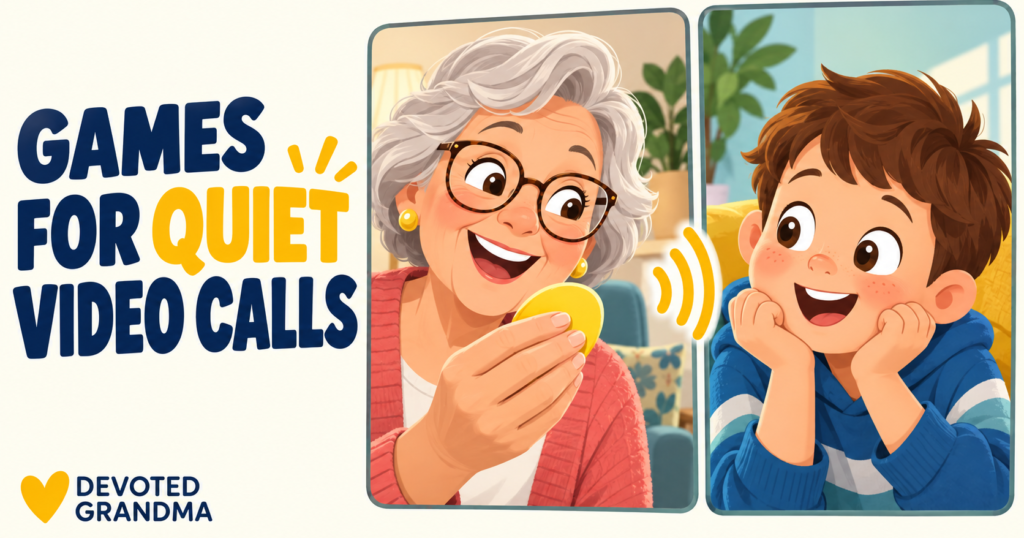
A video call can begin happily and go quiet surprisingly fast. You have asked about school, admired the latest drawing, and heard what the dog did. Now both of you are staring at the screen.
You do not have to fill every silence or persuade your grandchild to keep talking. Sometimes a tiny game gives you something enjoyable to do together. If they are tired or ready to leave, a warm goodbye may be the better choice.
Choose a game for this moment
- Only two minutes: Try 1, 2, 5, or 11.
- Low energy: Try 3, 6, 8, or 12.
- Ready to be silly: Try 4, 7, 9, or 10.
- Camera off: Try 1, 3, 5, 6, 8, or 12.
Offer one choice instead of reading the whole list: “Want to try a quick guessing game before we go?” A no is a complete answer.
1. The three-clue guess
First line: “I am thinking of something yellow, curved, and good in a lunchbox. What is it?”
Take turns describing an ordinary object with three clues. Younger children can use colors and shapes. Older grandkids can choose a movie, animal, hobby, or famous person. It works perfectly with audio only.
Easy ending: Play one guess each, then say, “That was a good one. Should we stop there?”
2. Find one thing
First line: “Can you find one thing near you that is smaller than your hand?”
Choose safe, simple qualities such as soft, blue, round, or older than they are. Little ones can show the object. Older grandkids can bring back something connected to a memory. If the camera is off, they can describe it instead.
Easy ending: Stop after each person finds one item.
3. This or that
First line: “Would you rather have pancakes for dinner or spaghetti for breakfast?”
Give two harmless choices and let each person explain as much or as little as desired. For older grandkids, use music, travel, food, or fictional worlds. This is an easy audio-only game.
Easy ending: Announce, “Final choice,” before the last question.
4. The sound maker
First line: “Close your eyes and guess what is making this sound.”
Tap a mug, crinkle paper, zip a jacket, or jingle keys. Young children may need two possible answers. Older grandkids can create tricky sounds for you. Audio is essential, but the camera can stay off.
Easy ending: Give each person two sounds, then reveal the final answer.
5. Five-second category
First line: “Name three animals that live in water. Ready, go!”
Choose categories that suit the child, such as fruits, superheroes, sports, songs, or things found in a kitchen. Skip the timer for younger children. Let older grandkids invent the categories. It works by audio.
Easy ending: Play three rounds and declare everyone a winner.
6. Build a tiny story
First line: “Once there was a chicken who found a purple suitcase.”
Add one sentence each until the story has a problem and an ending. A younger child can contribute one word that you turn into a sentence. An older grandchild can change the genre to mystery or science fiction. No camera is needed.
Easy ending: Say, “We each get one more sentence to finish it.”
7. Copy my face
First line: “Can you copy my surprised face?”
Take turns making gentle expressions, such as sleepy, puzzled, proud, or amazed. Keep it playful, never critical. Little ones may enjoy animal faces. Older grandkids might prefer silent reactions to imaginary situations.
Audio-only version: Replace faces with funny voices saying the same simple word.
Easy ending: Finish with matching smiles or waves.
8. Which memory was it?
First line: “Do you remember the day we saw that enormous dog?”
Offer one real shared detail and see what each person remembers. Do not turn it into a test or correct small differences. For a younger child, choose a recent visit. For an older grandchild, invite them to choose the memory. This works by audio.
Easy ending: Share one favorite detail each.
9. Invisible drawing
First line: “Watch my finger and guess what I am drawing in the air.”
Draw a heart, sun, letter, animal, or simple object. Young children need broad shapes. Older grandkids can draw titles or symbols. With cameras off, describe each line slowly while the other person guesses.
Easy ending: Each person draws twice.
10. The one-word makeover
First line: “Let us turn ‘The Three Bears’ into ‘The Three Giraffes.’”
Change one important word in a familiar story, song title, or movie title, then imagine what happens. Use nursery stories with little ones. Let older grandkids choose a title they know well.
Audio-only version: Nothing changes. The ideas are the game.
Easy ending: Invent one funny ending and stop there.
11. What changed?
First line: “Look carefully at me. I am going to change one small thing.”
Move a cushion, remove glasses, roll up a sleeve, or switch the hand holding a pencil. Make the change obvious for younger children and subtler for older ones. This game needs video.
Easy ending: Take one turn each, then reveal anything that was missed.
12. Fortunately, unfortunately
First line: “Fortunately, we found a treasure map. Unfortunately, it was inside a lion’s lunchbox.”
Alternate good and troublesome turns in an imaginary adventure. With younger children, use “Good news” and “Uh-oh” instead. Older grandkids can make the twists more complicated. It works well with audio only.
Easy ending: Agree that the next fortunate turn must bring everyone safely home.
Keep the call comfortable and safe
Check with parents about call timing, approved devices, and whether a child may move around the home with a camera. Never ask for a tour, an address, a school schedule, or a view of private rooms. If other people appear, give them privacy rather than making the camera follow them.
Follow the child’s energy. For more gentle long-distance connection, try these ways to share the after-school hour. If a grandchild does not want to talk or play, these responses can help you avoid adding pressure.
A good call does not have to be long. You can say, “I loved seeing you. We can play again another day,” and let the goodbye be warm. The game is an invitation, not a test of your bond.