Disclaimer: Devoted Grandma is reader-supported. If you purchase anything through my site, I may receive a small commission (at no cost to you). Thank you.
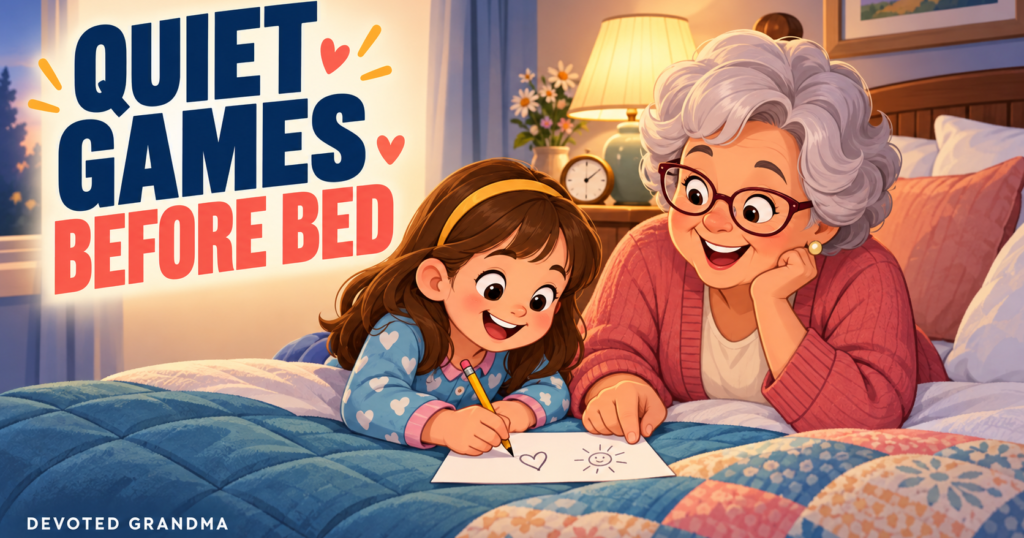
Bedtime is getting close, but your grandchild is not quite ready to say goodnight. There may be ten minutes to fill, very little energy left, and no desire to begin something that will be difficult to stop.
This is a lovely opening for a small game. You do not need supplies, a screen, or a complicated set of rules. If the parent has established a bedtime routine, let that routine set the boundaries. Then choose a game that fits the time and mood you actually have.
Choose a game for this moment
- You have about five minutes: Try 1, 2, or 3.
- You have ten to fifteen minutes: Try 4, 5, 6, or 7.
- Your grandchild wants to talk: Try 5, 8, or 9.
- Everyone needs to be very quiet: Try 3, 7, 10, or 11.
- You are already in the bedroom: Try 1, 4, 6, or 10.
Before beginning, name the limit kindly: “We have time for three rounds, and then we’ll continue getting ready for bed.” A clear ending makes the game feel complete instead of suddenly taken away.
1. Find Five
First move: Say, “Let’s find five things in this room that are blue.” Choose another color, shape, letter, or material for each round.
Young children can point. Older grandkids can choose a harder category, such as things that have a story. With siblings, take turns finding one item each. For less talking, use fingers to show the count. Stop after the promised category and say, “Five found. We did it.”
2. Three Clues
First move: Secretly choose something nearby and say, “It is soft, it is small, and it is beside the lamp.”
Give younger children obvious clues. Let older grandkids use trickier details that are still fair. One child can guess while you give clues, or siblings can alternate as clue-giver. For a quieter version, point to written letters or make simple gestures. End after everyone has given one set of clues.
3. Slow-Motion Copycat
First move: Slowly touch your nose, lift one hand, and tap two fingers together. Ask your grandchild to copy the sequence.
Keep it to two movements for little ones and add steps for older children. With siblings, one leads while the others copy. Nobody needs to speak. Avoid jumping or large movements. Finish with one final motion: hands resting quietly in laps.
4. Fortunately, Unfortunately
First move: Say, “Fortunately, a tiny dragon came to visit Grandma.” Your grandchild continues, “Unfortunately…” and adds a gentle problem.
For younger children, offer two possible ideas. Older grandkids can build a longer story. Siblings take alternating turns. If talking needs to stay low, whisper one sentence each. Settle the story after six sentences with a calm ending, such as the dragon finding its way home.
5. The Best Little Part
First move: Ask, “What was one little part of today that you would keep if you could?”
A younger child may name a snack, joke, or game. An older grandchild can share as much or as little as desired. With siblings, let each person answer without comparing choices. A child who does not feel like talking can hold up a finger for “I have one” and keep it private. End with, “I’m glad I got to share part of today with you.”
If questions sometimes feel like pressure, this gentle invitation pattern can help you offer connection while leaving room for an honest no.
6. Add One Detail
First move: Begin, “There was a little cabin beside a lake.” Ask your grandchild to add one detail.
Young children can choose between two details: “Was the door red or green?” Older grandkids can add characters and surprises. With siblings, go around in a circle. For a low-talking version, each person adds only one word. Stop when the cabin has five details, then describe the finished scene together.
7. Finger Drawing
First move: Trace a simple shape with your finger on the blanket, tabletop, or in the air. Ask your grandchild to guess it.
Start with a circle or heart for younger children. Older grandkids can trace letters, objects, or a short word. Siblings take turns drawing and guessing. This game can be completely silent. Announce the last turn before it begins, then finish with an easy shape everyone can recognize.
8. Would You Rather, Cozy Edition
First move: Ask, “Would you rather have a reading nook in a tree or a tiny library under the stairs?”
Keep choices concrete for younger children. Invite older grandkids to explain their answer or invent the next question. With siblings, everyone answers before a new choice begins. For less talking, show one finger for the first choice and two for the second. End after five questions, with your grandchild choosing the last one.
9. A Tiny Memory
First move: Say, “Tell me one tiny thing you remember from a happy day.” If they prefer, offer one simple family memory of your own without insisting that they remember it too.
Young children may remember something recent. Older grandkids might choose a trip, holiday, or ordinary afternoon. With siblings, each gets an uninterrupted turn. A low-talking child can name only a person, place, or object. Close by saying, “That was a good one to remember.”
Memories can also highlight how quickly grandchildren change. These ideas for staying close as grandkids grow offer practical ways to meet them at each new stage.
10. Paper-and-Pencil Paths
First move: If paper and a pencil are already handy, draw two dots and connect them with a winding line. Ask your grandchild to add another path without crossing yours.
Little ones can simply connect dots. Older children can create a small maze. With siblings, use different sections of the page or take turns adding one line. No talking is required. Stop when the page has six paths, then circle a favorite together.
11. Finish the Picture
First move: Draw one curved line and ask, “What could this become?”
For younger children, let it become any recognizable object. Older grandkids can turn several random marks into one scene. With siblings, pass the paper after every added line. For a nearly silent version, draw without explaining until the end. Give a two-line warning, then add one final mark and admire the result without starting another picture.
A calm ending is part of the game
The best choice is not necessarily the cleverest game. It is the one that suits the grandchild, respects the parent’s routine, and can end without a struggle.
Try a consistent closing sentence: “That was our last round. Thank you for playing with me.” If disappointment appears, acknowledge it without reopening the game: “You wanted another turn. We can remember this one for another visit.”
A few playful minutes do not need to become a grand production. They can simply be a warm little bridge between the busy part of the visit and whatever comes next.