Disclaimer: Devoted Grandma is reader-supported. If you purchase anything through my site, I may receive a small commission (at no cost to you). Thank you.
A family recipe does not have to be secret, famous, or generations old to be worth keeping.
It might be the macaroni salad everyone requests, the pancakes a grandchild always helps stir, or the simple snack that appears whenever the family gathers. What makes it meaningful is the memory attached to it and the people who make it together.
This activity has one clear goal: Grandma and a grandchild will finish one usable recipe card together. You will preserve the recipe accurately while giving your grandchild a genuine part in creating the card.
This is not a project for assembling an entire family cookbook. One recipe, one card, and one shared session are enough.
Choose a Recipe That Feels Comfortable to Share
Begin with a recipe you know well enough to explain. It can come from a relative, a familiar cookbook, a food package, or your own everyday cooking. If it came from a published source, write down where it came from rather than presenting it as an original family recipe.
Before inviting your grandchild, consider whether anyone might feel protective of the recipe. Some instructions are connected to grief, complicated relationships, or a relative who preferred to keep them private. You do not have to turn every food memory into a family activity.
If sharing the recipe could hurt or embarrass someone, choose another. A grilled cheese sandwich made your favorite way can carry more warmth than a guarded recipe that causes tension.
Check with the child’s parent about food allergies, dietary needs, kitchen rules, and which tools the child may use. Follow the parent’s guidance, even if it differs from what your own children were allowed to do at that age.
This is one of those small moments when respecting the parents’ role helps everyone relax. The same principle appears in these reminders about supporting parents when they are present.
Give Your Grandchild a Real Job
A child does not become a co-creator simply by watching Grandma cook and copying her words afterward. Offer a role that makes a visible difference to the finished card.
Depending on the child’s age and the parent’s boundaries, your grandchild could:
- Measure or count safe ingredients.
- Read each step aloud while you check it.
- Suggest a clear name for the recipe.
- Write the ingredient list or directions.
- Draw one small picture of a recognizable ingredient.
- Help test one simple, clearly labeled variation.
Let the child choose from two or three realistic jobs. You might say, “Would you like to write the ingredients, draw the strawberry, or help us choose a name?”
That invitation gives your grandchild ownership without making the whole activity feel like a test. It uses the same gentle idea as offering a five-minute tour of something your grandchild loves: give the moment a comfortable boundary, then let the child lead within it.
Record the Original Recipe Accurately
Before changing anything, make the recipe once as it is normally prepared. Pay attention to details that may live in your memory but not on paper.
“Add a little milk” may make perfect sense to you. A grandchild using the card later will need a better clue. Measure that amount if you can. Notice the pan size, approximate cooking time, signs that the food is ready, and any important order in which ingredients are added.
As you work, invite questions. A child may notice that “one package” is not very helpful unless the package size is included. That is exactly the kind of contribution that makes the finished card more useful.
If a measurement cannot be exact, describe what to look for: “Stir in milk one tablespoon at a time until the batter drops slowly from the spoon.” Honest guidance is better than pretending every family recipe is perfectly precise.
Add One Labeled Variation, If You Want One
Your grandchild may have an idea for making the recipe partly their own. Perhaps they want cinnamon in the applesauce, blueberries in the pancakes, or a different cheese in the sandwich.
Keep the original instructions intact. Put the new idea in a separate section labeled Our variation. That distinction respects the recipe you started with and lets your grandchild’s contribution be seen.
Only include a variation you have actually tried or can describe honestly. If the idea remains untested, label it Try next time instead of promising that it works.
Make the Card Together
Use a sturdy index card, recipe card, or sheet of paper that can be stored safely. Include:
- The recipe name.
- The source, if known.
- A complete ingredient list with amounts.
- Directions in the correct order.
- Cooking time, temperature, and serving amount when relevant.
- The clearly labeled variation, if you made one.
- The date and both of your names.
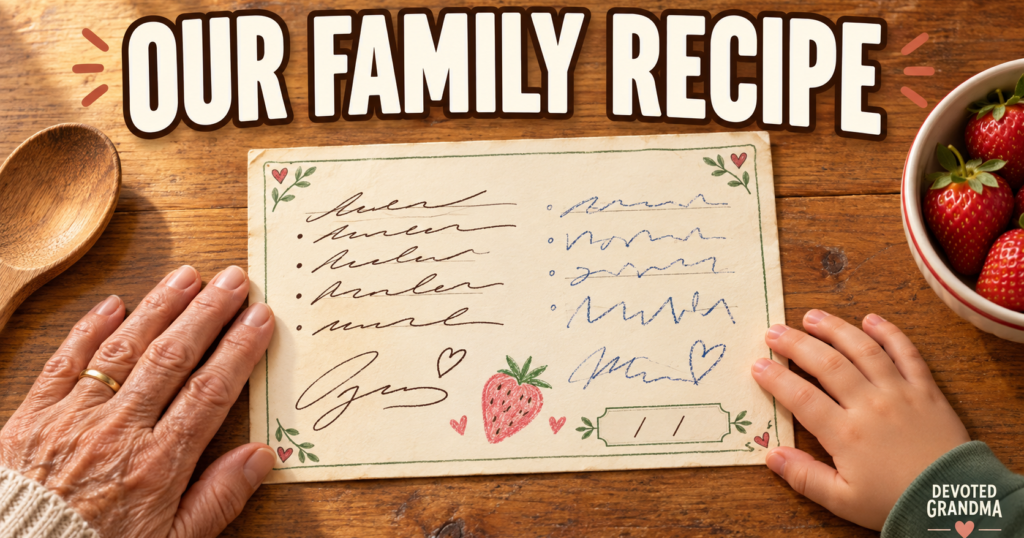
Leave room for both generations’ handwriting. Grandma might write the directions while her grandchild writes the title and variation. A younger child can add a few letters, sign a name, or draw the ingredient picture while Grandma records the practical details.
Do not worry about making the card look professionally printed. A crossed-out word or slightly crooked strawberry may become part of its charm. The important standard is that someone can read the card and use it.
If You Live Far Apart
You can make the card during a video call. Choose the recipe with the parent ahead of time and make sure both kitchens have safe ingredients and suitable supervision.
Grandma can prepare the original recipe while the grandchild reads the steps, checks quantities, chooses the title, or creates the illustration. Hold each section up to the camera as it is completed.
Afterward, Grandma can mail the card to the child for their contribution, or each person can complete one section on separate paper. Combine the sections on one final card, then send a photograph or copy back to the other household.
If cooking at the same time is impractical, use a no-cook recipe such as a fruit cup, sandwich, snack mix, yogurt parfait, or flavored cream cheese. Parent approval and allergy guidance still come first.
Let the Finished Card Be Enough
When the card is complete, read it together from beginning to end. Ask, “Could another person make this without us standing beside them?” Add any missing detail you discover.
Then sign it, date it, and decide where it will live. You might place it in Grandma’s recipe box, give it to the grandchild, or make a copy for each home.
The deepest value is not that you preserved a flawless culinary treasure. It is that your grandchild did more than watch. Their words, handwriting, question, idea, or drawing helped turn a familiar food into something useful that the two of you made together.