Disclaimer: Devoted Grandma is reader-supported. If you purchase anything through my site, I may receive a small commission (at no cost to you). Thank you.
Some of the best outings begin long before anyone gets in the car. They begin when two people lean over a map and say, “I want to show you this place.”
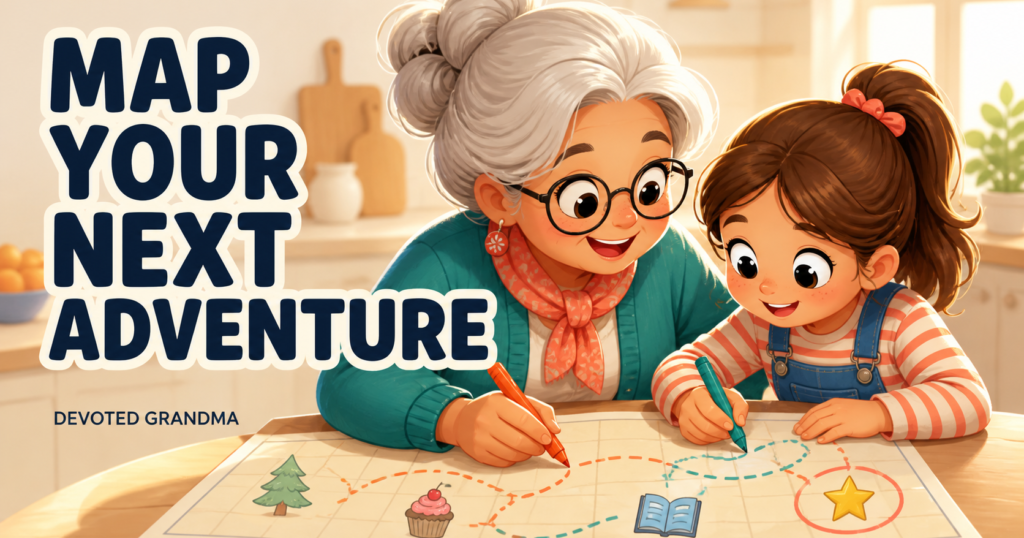
A shared map gives Grandma and her grandchild an easy way to be curious about each other. You each choose two places, mark them on one map, and explain why they caught your attention. Then you circle one place that could become a real outing.
This is not a list of local attractions or a promise to visit everywhere. It is a small, finishable project. When you are done, you will have a map that belongs to both of you and one clear next step.
Start With the Simplest Map That Works
A paper map is lovely because you can write on it, add color, and keep it afterward. You might use a printed neighborhood map, a road map, or a hand-drawn outline showing a few familiar roads and landmarks.
A digital map also works, especially if your grandchild enjoys using a phone or computer. Save each choice as a pin or bookmark. If technology begins taking over the activity, return to paper. The purpose is to discover places together, not master an app.
Gather only what you need:
- One paper or digital map
- Two different colored pens, pencils, or markers
- A small piece of paper for notes
- A calendar for choosing a possible date
Choose one color for Grandma and another for the grandchild. Seeing both colors on the finished map makes it clear that both people contributed.
Choose Two Places Each
Each person now chooses two places. Keep the number small. Four total choices are enough to create variety without turning the project into a long search.
A place does not need to be famous or impressive. It could be:
- A park with a good walking path
- A bakery with a favorite treat
- A library, garden, farm stand, mural, or playground
- A place connected to a family memory
- A free event you would both enjoy
- A quiet spot where you can sit and talk
- A place neither of you has visited but both find curious
Try to include one place that already means something to you and one place you would like to discover. Your grandchild can do the same.
If broad questions usually lead to “I don’t know,” offer a narrower choice: “Would you rather mark a place with good food, something interesting to see, or somewhere we could be outdoors?” The same principle can make other conversations easier. These alternatives to predictable Grandma questions may help when you want to hear more than a one-word answer.
Mark the Map Together
Take turns adding your places. As each person makes a mark, write a short label beside it. A younger child might draw a tiny picture instead. A teen may prefer a simple dot and name.
Resist the urge to correct every crooked line or misspelled label. This is a shared working map, not a school assignment. Its value comes from the choices and stories on it.
If a location is outside the area shown, draw an arrow toward it and add the name near the edge. If you cannot find an exact address, an approximate mark is fine for now. You can confirm the details before making plans.
Tell the Meaning Behind Each Choice
Once all four places are visible, compare them. Give each person an uninterrupted turn to explain a choice.
You might ask:
- “What made you choose this one?”
- “What would you want to do there?”
- “Who or what does this place remind you of?”
- “What do you hope I would notice there?”
Grandma should answer too. Reciprocal discovery is the heart of the project. Your grandchild is not simply supplying ideas for you to approve. You are both revealing a little of what you enjoy, remember, or wonder about.
Listen for small details. A grandchild may care less about a large playground than the ducks beside it. Grandma may choose an old neighborhood because she wants to point out the route she once walked. Those details turn a dot on a map into a personal invitation.
Check What Is Truly Possible
Before choosing an outing, gently check the practical details. This keeps anticipation from becoming disappointment.
- Parent approval: Ask the child’s parent or guardian before promising an outing, especially if travel, admission, food, or a change in routine is involved.
- Cost: Include admission, transportation, parking, snacks, and any equipment. It is perfectly fine to choose a free place.
- Accessibility: Consider walking distance, seating, restrooms, noise, crowds, weather, and mobility needs.
- Timing: Check opening hours, travel time, school schedules, and how much energy both of you are likely to have.
- Suitability: Make sure the setting and activity fit the child’s age and family rules.
These checks do not spoil the fun. They help you find the choice that can move from an appealing idea to an enjoyable day.
Circle One Outing and Give It a Next Step
Look at the four choices and circle one realistic outing together. It does not have to be the most exciting place. Choose the one that fits your current time, budget, energy, and family circumstances.
If several choices work, take turns. Choose your grandchild’s place first and Grandma’s next time, or save the remaining dots for another season. A simple decision method can prevent the choosing from becoming the whole event. The approach in this two-generation movie-night plan can also help when two good preferences need a fair decision.
Now give the circled place one concrete next step:
- Ask a parent for approval
- Check the hours and cost
- Choose a possible date
- Arrange transportation
- Put aside a small outing fund
Write that step beside the circle. If possible, decide who will do it and when. “Grandma will check Saturday hours tonight” is more useful than “We should go sometime.”
Adapt the Project to Your Family
For an at-home version: Map meaningful places inside the house or yard. Mark the best reading chair, a family photograph, the place where cookies cool, or a spot for a picnic. Circle one place and enjoy a tiny activity there that day.
For long-distance grandkids: Share a map on a video call. Each of you can mark two places near your own home. Choose one place to visit separately, then exchange pictures or talk about what you noticed.
For limited mobility: Look for level entrances, close parking, seating, accessible restrooms, or places that can be enjoyed from the car. A scenic overlook, drive-through display, or accessible library may offer a better experience than a demanding destination.
For rural families: Your dots might include a creek, farm stand, church picnic ground, historical marker, country road, or neighbor’s produce table. Meaning matters more than the number of attractions nearby.
For a no-spend outing: Choose a public park, free museum day, library event, neighborhood walk, community garden, or family-history drive. Bring water and a snack from home if that makes the plan easier.
Keep the Finished Map
Add the date and both of your names when the map is complete. After your outing, you can place a star beside the destination and write one thing each of you remembers.
The uncircled places do not become obligations. They are possibilities. Your finished map is already worthwhile because it shows that Grandma’s interests and a grandchild’s interests can share the same page.
Four marks, two colors, and one circle are enough. The next adventure may be modest, but it will begin with something important: each of you saying, “Here is a place I want to share with you.”