Disclaimer: Devoted Grandma is reader-supported. If you purchase anything through my site, I may receive a small commission (at no cost to you). Thank you.
Grandma is often the teacher.
We show grandchildren how to measure flour, sew on a button, tend a garden, write a thank-you note, or play the card games we grew up loving.
But this weekend, try turning the lesson around.
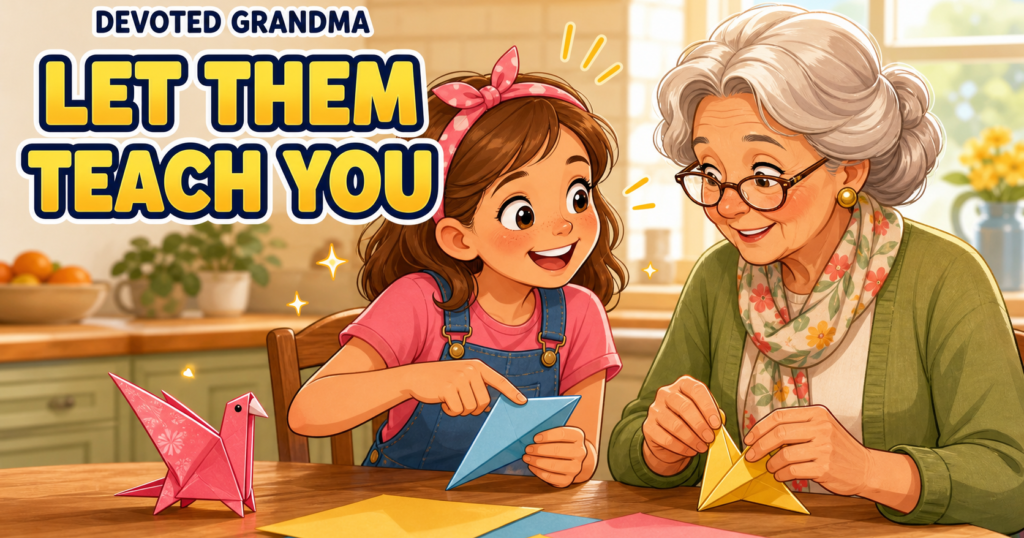
Ask your grandchild to teach you one small thing they know how to do. It could be a dance step, a drawing trick, a basketball move, a favorite game, an app feature, a few words from a language they are studying, or an interesting fact about something they love.
The point is not to pretend that you cannot do something. It is to become an honest beginner and give your grandchild a chance to lead.
That role can feel wonderfully different to a child. Instead of being corrected, directed, or helped, they get to choose, explain, demonstrate, and hear Grandma say, “I learned that from you.”
Begin With a Natural Invitation
A grandchild may become suspicious if the invitation sounds like a carefully planned character-building exercise. Keep it light and genuine.
You might say:
- “You know much more about that than I do. Would you teach me one little part?”
- “I would love to learn something from you this weekend. What would be fun to show me?”
- “Could you give me a ten-minute beginner lesson?”
Specific invitations can be easier than a broad question. “Will you teach me something?” may leave a young child staring blankly. Instead, mention an interest you have already noticed: “Would you show me how you make that paper animal?” or “Could you teach me the easiest move in your game?”
Give your grandchild room to decline or suggest another subject. Agency is part of the activity. If they do not want to teach the skill you noticed, ask what they would prefer—or simply try again another day.
Keep the Lesson Small
The best version of this activity is pleasantly manageable. You are not asking for a complete course in video editing, soccer, chess, or dinosaurs. You are asking for one small success.
A lesson might be:
- How to draw one cartoon face
- How to perform one simple magic trick
- How to find and send a funny picture on a phone
- How to build a tiny structure with blocks
- How to make one friendship bracelet knot
- How to recognize a favorite bird, planet, or dinosaur
- How to play one round of a game
- How to say and pronounce one useful phrase in another language
Ten or fifteen minutes may be plenty, especially for a younger grandchild. A bounded lesson keeps the invitation from feeling like a performance and gives both of you a clear finish line.
Be an Appreciative Beginner
It can be surprisingly hard for an adult to surrender the expert’s chair. You may understand the subject already, spot a faster method, or feel tempted to improve your grandchild’s explanation.
For this short lesson, let their method have room.
If you need help, ask for it without making yourself the joke. You can say, “I missed that step. Will you show me again?” or “You made that look easy. Let me try more slowly.”
A small mistake can even help the lesson. It gives your grandchild a chance to notice what happened and offer guidance. The aim is not to act helpless. It is to listen, try, and allow them to be useful.
This is closely connected to helping grandchildren become capable and confident. The article How Grandmas Can Help Their Grandchildren Become More Independent offers more ways to give children space to think, choose, and try.
Ask Questions That Honor Their Knowledge
Curious questions show that you are paying attention. They also help a child think through something they may usually do without explaining it.
Try questions such as:
- “Which part took you the longest to learn?”
- “What mistake do beginners usually make?”
- “What is your favorite part of this?”
- “How did you first become interested in it?”
- “What should I practice if I want to remember?”
Follow the child’s energy. Some grandchildren will enjoy a stream of questions. Others will prefer to demonstrate quietly. A teenager may respond better if you join them casually instead of turning the moment into an interview.
Avoid testing them, correcting minor details, or comparing their skill with someone else’s. This is their chance to share, not an examination they must pass.
Show What You Genuinely Learned
End the lesson by doing or recalling the small thing your grandchild taught you.
Draw the cartoon face. Complete the game move. Repeat the new phrase. Find the phone feature. Point to the planet they helped you recognize.
Then name something specific: “I learned that the knot has to stay loose until the last step,” or “Now I know why you choose that move first.”
Specific appreciation means more than broad praise because it proves you noticed their teaching. You could also say, “You explained that clearly,” or “You were patient when I needed another try.”
If it feels natural, use the skill later and mention it: “I remembered what you showed me.” That small follow-through turns a pleasant activity into evidence that their contribution mattered.
Adapt It to Your Grandchild and Your Situation
For younger children
Offer two or three concrete choices and keep the lesson short. They might show you how to arrange stuffed animals for a game, make a block tower, sing a classroom song, or draw their favorite animal.
For tweens and teenagers
Respect their interests even when those interests are unfamiliar to you. Ask for one accessible piece of a game, sport, hobby, music style, or technology. Do not ask them to become your permanent technology helper. This is a shared moment, not an unpaid job.
For adult grandchildren
The activity still works. An adult grandchild might demonstrate a cooking technique, explain part of their work, recommend a useful phone setting, or teach you something connected to a hobby.
For long-distance families
Arrange a short video call or exchange simple photos and voice messages. Your grandchild can demonstrate a step, and you can send back your attempt. A regular phone call also works for trivia, pronunciation, storytelling, or anything that does not require seeing the action.
For different abilities
Choose a lesson that is comfortable for both of you. A grandchild who does not enjoy verbal explanations might demonstrate, point, draw, or select pictures. If movement, vision, hearing, dexterity, or energy is limited, pick an activity that can be adapted without making the adaptation the center of attention.
For a small budget
No purchase is necessary. Use objects already at home, a free feature on a device you already own, a song, a movement, a fact, or a pencil and scrap paper. Your attention is the important material.
Let the Gift Be Mutual
Grandmothers have much to give, but closeness does not require us to do all the giving. Sometimes receiving a grandchild’s help graciously is its own form of love.
The most memorable part may not be the skill itself. It may be the moment your grandchild realizes that Grandma takes their interests seriously and trusts them to lead.
Practical help can leave a lasting mark in families, especially when it is offered with respect. For another perspective on meaningful support, read The Kind of Help Grandchildren Remember Grandma Giving for the Rest of Their Lives.
Before the weekend arrives, choose one grandchild and make one small invitation. Set aside ten or fifteen minutes, put away distractions, and become their student.
Then give them the satisfaction of hearing the honest words: “You taught me something today.”