Disclaimer: Devoted Grandma is reader-supported. If you purchase anything through my site, I may receive a small commission (at no cost to you). Thank you.
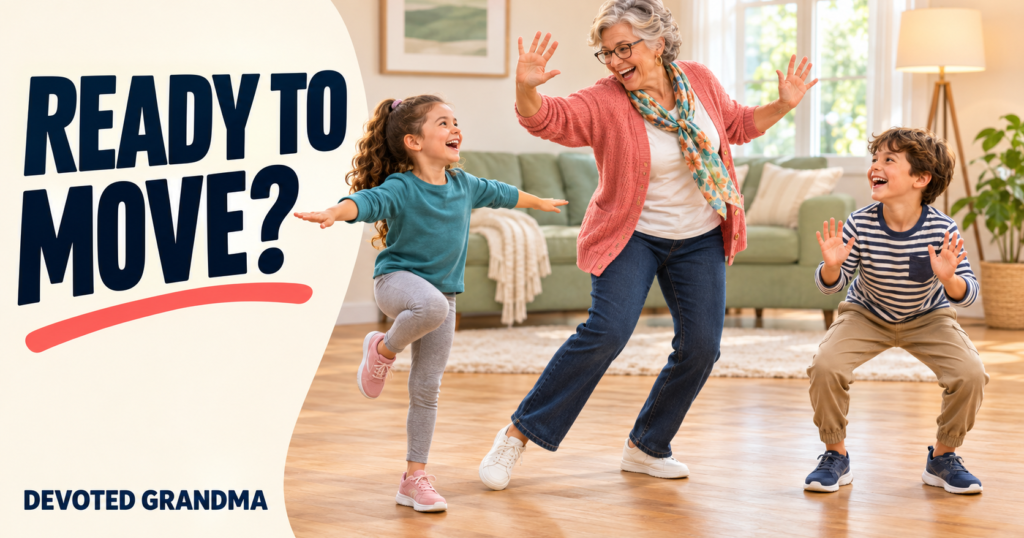
When your grandkids are full of energy and going outside is not practical, you do not need a closet full of toys to get them moving. A clear patch of floor and one simple idea can be enough.
Choose a game that fits the room and the kind of energy you see. Before you begin, move drinks, cords and breakable objects out of the play area. Remind everyone that careful movement matters more than speed.
Choose your starting game
- Very little space: Start with Mirror Me.
- A clear room and plenty of energy: Start with Follow My Path.
- Ready to settle down: Start with Slow-Motion Parade.
You can adapt any game to suit your grandchild’s age, mobility and comfort. Sitting, standing and smaller movements all count. If someone feels pain, dizziness or discomfort, stop and choose a gentler activity.
Small-space games
1. Mirror Me
Start: Face each other and say, “Pretend I am your mirror. Copy what I do.” Slowly reach up, bend your knees, tap your shoulders or sway from side to side. After several movements, let your grandchild lead.
Adapt it: Younger children can copy one movement at a time. Older grandkids can create short sequences for you to remember. Anyone who prefers to sit can play with arm movements and facial expressions.
Keep it safe: Use slow, controlled motions and keep both feet planted during bends or reaches.
Stop: Finish with matching waves, then say, “The mirror is closed.”
2. Animal Actions
Start: Call out an animal and choose a movement that fits it. Stretch tall like a giraffe, flap like a bird or take tiny steps like a mouse.
Adapt it: Give younger children two animals to choose from. Older grandkids can invent an animal action and challenge everyone else to guess it.
Keep it safe: Skip crawling if the floor is hard, crowded or slippery. Choose standing or seated actions instead.
Stop: Announce that every animal is going to sleep, then curl your hands under your cheek for one quiet breath.
3. Traffic Light
Start: Explain that green means move in place, yellow means move slowly and red means freeze. Call the colors in a mixed-up order.
Adapt it: Little ones can march on green. Older children can choose a different safe motion for each round. A seated player can tap feet or move arms.
Keep it safe: Keep the movement in one assigned spot. Freezing should mean becoming still, not making a sudden jump or drop.
Stop: Call, “Red light, game over,” and hold the final freeze for a count of three.
4. Reach and Count
Start: Pick a number from one to ten. Reach high, reach to each side, tap your knees and repeat until you reach that number.
Adapt it: Younger children can count aloud with you. Older grandkids can make a repeating pattern or count backward.
Keep it safe: Use comfortable reaches and do not bounce or force a stretch.
Stop: Complete the chosen number, shake out your hands gently and say, “That set is done.”
Whole-room games
5. Follow My Path
Start: This is the best first choice when you have a clear room. Lead everyone around an imaginary path. Walk beside the couch, circle a chair and tiptoe across an open patch of floor. Then choose a new leader.
Adapt it: Keep the path short for younger children. Older grandkids can add a movement at each turning point, such as two claps or one careful spin.
Keep it safe: Walk the route once before play begins. Remove tripping hazards and make walking the rule, even when excitement rises.
Stop: Lead the path to a designated finish and give the leader a round of applause.
6. Corner Call
Start: Give each open corner or safe area a simple name, such as sun, moon, star and cloud. Call one name, and everyone walks there.
Adapt it: Use only two destinations for little ones. Older children can become the caller or remember a sequence of two or three places.
Keep it safe: Choose destinations away from furniture edges, stairs and doors. Everyone walks, with no racing or tagging.
Stop: Call everyone to the middle for one last group clap.
7. Move Like This
Start: Name a way to cross the room: giant steps, tiny steps, sideways steps or quiet tiptoes. Everyone travels to the other side and waits.
Adapt it: Younger children can copy you. Older grandkids can take turns naming movements. A child who needs less movement can do the action beside a chair.
Keep it safe: Do not use backward movement unless the route is completely clear and an adult is watching closely.
Stop: Choose one final slow walk back to the starting place.
8. Invisible River
Start: Pretend a narrow river runs across the room. Choose a safe way over it, such as one long step, three little steps or a careful walk along its imaginary bank.
Adapt it: Make the river very narrow for younger children. Older grandkids can describe a new route without adding real obstacles.
Keep it safe: Keep both feet close to the floor. No leaping over furniture, rugs or other people.
Stop: Once everyone reaches the final bank, announce that the bridge is closed.
Games that help the room grow calmer
9. Slow-Motion Parade
Start: This is the best first choice when lively play needs a gentler ending. Form a parade and move across the room as slowly and quietly as you can.
Adapt it: Younger children can follow your pace. Older grandkids can lead with smooth hand motions. Seated players can make a slow parade with hands and arms.
Keep it safe: Leave space between players and keep eyes open while moving.
Stop: Let the parade arrive at its destination, then take one quiet breath together.
10. Quiet Copycat
Start: Make one gentle motion without speaking, such as rolling your shoulders, opening and closing your hands or lifting one foot. Everyone copies you silently.
Adapt it: Use very simple motions for younger grandkids. Let older children lead several movements in a row.
Keep it safe: Avoid difficult balancing. A wall or sturdy chair may be used for support, with an adult nearby.
Stop: End with hands resting in laps or at your sides, then whisper, “Copycat complete.”
11. Growing Flower
Start: Pretend to be a tiny seed by making your body small in a comfortable standing or seated position. Slowly grow, lift your arms like petals and gently sway.
Adapt it: Younger children can follow a short story about sun and rain. Older grandkids can take turns narrating how the flower grows.
Keep it safe: No one needs to crouch deeply or sit on the floor. Use whatever range of motion feels comfortable.
Stop: Let the flower become still in the sunshine, then lower your arms.
12. Five-to-One Moves
Start: Do five gentle marches, four shoulder taps, three side reaches, two quiet claps and one deep, comfortable breath.
Adapt it: Make every action seated for a younger or less mobile player. Older children can choose the motions for a second round.
Keep it safe: Keep movements easy and unhurried. No one should hold their breath or stretch farther than is comfortable.
Stop: The countdown provides a natural finish. After the final breath, say, “All done.”
Make the ending easy
A good stopping point can prevent a happy game from stretching into an argument. Give a brief notice, such as, “We will do this one more time, and then we are finished.” Follow through with the ending built into the game.
If toys came out before the movement break, you can use one of these gentle ways to make cleanup feel like time together. If active play is leading toward an overnight routine, these ideas for a familiar bedtime at Grandma’s house can help you make the next part of the visit more predictable.
You do not need to play all 12 games. Pick the one that matches your room, your grandkids and the moment in front of you. A few minutes of simple movement, followed by a clear ending, may be exactly what the visit needs.