Disclaimer: Devoted Grandma is reader-supported. If you purchase anything through my site, I may receive a small commission (at no cost to you). Thank you.
There will be moments in a grandchild’s life when Grandma wants to be in the front row, at the kitchen table, or waiting nearby with a hug.
Sometimes distance, health, schedules, or family circumstances make that impossible. We cannot attend every performance, move, hard school day, or quiet personal victory. But our loving words can still reach a grandchild at the right time.
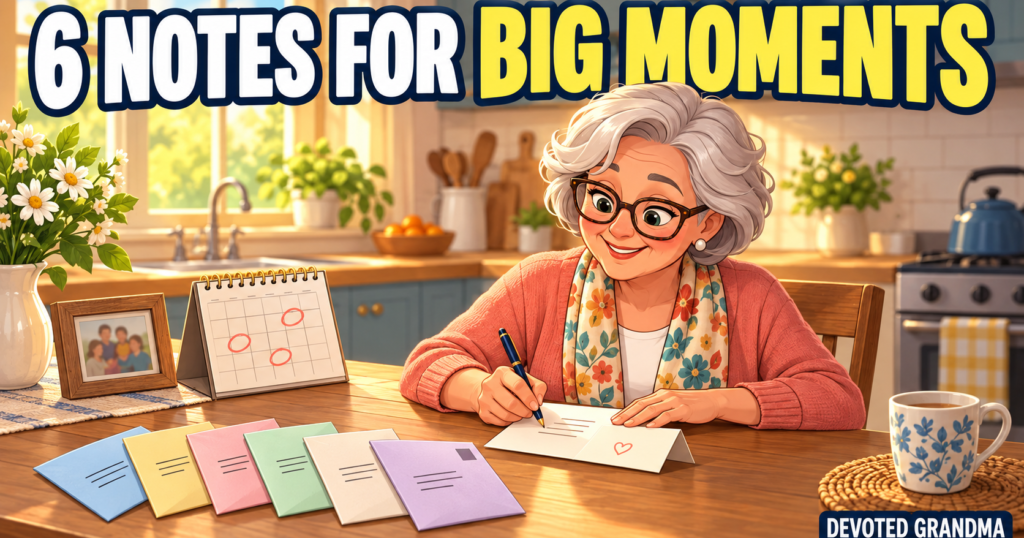
This simple workshop will help you prepare six notes for future moments. They are not farewell letters, and they do not need to sound grand or poetic. Think of them as small pieces of steady encouragement, ready when your grandchild needs them.
You can write all six now, or outline them and finish each one when the occasion approaches.
Before you begin, coordinate with the parents
Ask your grandchild’s parent which coming events are appropriate and how the notes should be delivered. A parent may know that a child wants encouragement before a performance but prefers quiet afterward. They can also help you avoid revealing a surprise or mentioning information the child has not been told.
Write the occasion and suggested delivery time on each envelope. Keep the actual message flexible enough to remain truthful if plans change.
A good note usually contains three things:
- A clear acknowledgment of the moment
- One true detail that shows you know this particular grandchild
- Support without advice, pressure, or a request for a reply
1. A note for a first performance
A first concert, recital, play, speech, or game can bring excitement and nerves at the same time. Your note does not have to predict success. Let your grandchild know that courage matters more than a flawless result.
Flexible prompt: “I know you have been getting ready for this. I hope you can take one deep breath, notice how far you have come, and enjoy being part of it.”
Add a true detail, such as the song they practiced, the position they learned, or the way they kept going after a difficult rehearsal. For a young child, use two or three cheerful sentences. For a teen, keep your encouragement sincere and free of babyish praise.
Ask a parent whether the note should arrive the night before, that morning, or after the event. It can be mailed, tucked into a bag, read over the phone, or sent as a photograph of your handwritten card.
2. A note for a difficult test or challenge
This note is for a demanding exam, tryout, interview, medical appointment, or other challenge. Support is more useful than a list of instructions, especially when your grandchild is already carrying plenty of expectations.
Flexible prompt: “This may feel like a big day. You do not have to prove your worth to me. I am thinking of you and hoping you feel calm, prepared, and supported.”
Include one honest reminder of something you have observed: perhaps they asked for help, practiced patiently, or returned to a task after becoming discouraged. Avoid promising that everything will work out. Your affection does not depend on the result.
For younger children, replace abstract words with something simple, such as, “I love you on easy days and hard days.” A parent can help you judge whether contact beforehand will comfort the child or add pressure.
3. A note for a new responsibility
A first job, a pet-care duty, a driver’s license, or a leadership role can make a grandchild feel proud and uncertain. This is a chance to recognize growing responsibility without turning the note into a lecture.
Flexible prompt: “You are taking on something new, and I am glad to see you trusted with it. I hope you give yourself time to learn. Nobody begins by knowing everything.”
Make it personal by naming a quality you have genuinely seen, such as carefulness, kindness, punctuality, or a willingness to ask questions. Do not claim that the new role proves they are finally mature.
A small child may enjoy a note beside a simple drawing. An older grandchild might appreciate a short text on the first day. Check with the parents before sending money, gifts, or advice along with it.
4. A note for a team milestone
Your grandchild may reach a tournament, final performance, group exhibition, service-project finish, or club celebration. Keep the attention on their experience and the people who shared it.
Flexible prompt: “You and your group have worked toward this day. I hope you enjoy what you created together and remember the people who helped one another along the way.”
Mention a true detail about their contribution, but do not give them sole credit for a shared accomplishment. If the outcome is uncertain, celebrate their participation rather than predicting a win.
This distinction matters whenever happy news arrives. The ideas in 12 Ways to Celebrate Your Grandchild’s Good News Without Stealing the Moment can help you keep the joy centered on your grandchild.
5. A note for a move or new beginning
A move, school change, or new family routine can carry hope and sadness together. Resist the urge to insist that your grandchild will love everything soon. Begin by making room for mixed feelings.
Flexible prompt: “A new beginning can feel exciting, strange, and tiring all at once. You do not have to choose just one feeling. I would love to hear about the small things you notice when you are ready.”
Add something true about what will remain steady, such as your regular Sunday call or the family joke you always share. Do not promise that relationships or routines will stay exactly the same.
For more ways to listen without rushing a child past loneliness, see When Your Grandchild Is Struggling To Fit Into A New Environment.
Ask the parent when the note would be most welcome. The first night may be overwhelming, while a card arriving one week later could feel like a warm connection to familiar people.
6. A note for an ordinary personal breakthrough
Some of the most meaningful milestones never appear on a calendar. A grandchild may make a friend, speak up, learn to manage a frustration, finish a book, apologize sincerely, or try again after failing.
Flexible prompt: “I heard about what you did, and I wanted you to know I noticed. That took patience and courage. I am glad for you.”
Be specific about the action, but avoid fixing a permanent label to the child. “You practiced even when it was frustrating” is more grounded than “You are the strongest person I know.” Celebration should help them feel seen, not require them to maintain an image.
Because these breakthroughs are unpredictable, leave this envelope partly unfinished. Write the opening now and add the truthful detail later. Coordinate with a parent so you do not share something the child expected to remain private.
Finish your six-note set
Place six envelopes in a folder and label them: first performance, difficult challenge, new responsibility, team milestone, new beginning, and personal breakthrough. Add your grandchild’s name and a pencil note about possible delivery timing.
Read each message once and remove anything that asks for reassurance, such as “Write back so I know you got this” or “I wish you needed me more.” Your grandchild should not have to care for your feelings while handling a big moment.
Then look for one true, personal detail in every note. It may be small. Small details often carry the warmth: the purple music folder, the carefully packed lunch, the dog waiting beside the moving boxes, or the joke that made a hard practice easier.
You may not be able to stand beside your grandchild for every milestone. Still, with a little preparation and thoughtful family coordination, your words can arrive carrying something valuable: Grandma knows me, Grandma is thinking of me, and Grandma’s love does not depend on how this turns out.