
Disclaimer: Devoted Grandma is reader-supported. If you purchase anything through my site, I may receive a small commission (at no cost to you). Thank you.
You planned a cheerful visit. Perhaps you pictured a favorite game, a little baking, or a long conversation at the kitchen table.
Then the day arrives, and somebody has less energy than expected. It might be you. It might be your grandchild. It might be both of you.
That does not mean the visit has failed. It simply needs a softer shape.
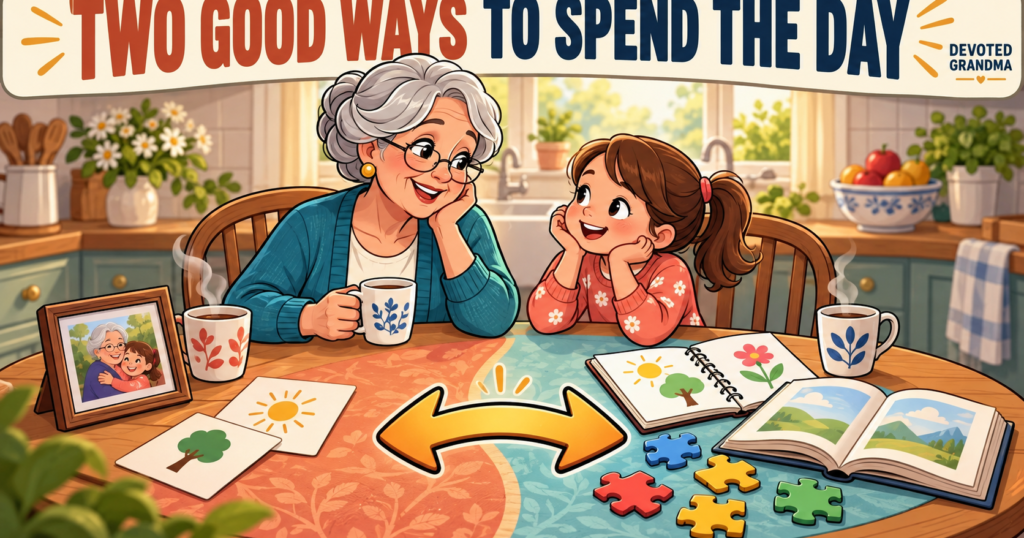
A two-path visit plan gives you two equally good ways to spend your time together. One path leaves room for talking and choosing. The other lets you enjoy quiet company with very little pressure. You can begin with either one and switch whenever you need to.
A completed two-path plan
Here is a simple example you can copy:
Path one: Talk and choose
- Start: Share a drink or snack.
- Connect: Pick two conversation cards or look through three family photos.
- Choose together: Decide whether to play a short game, make something simple, or continue talking.
- Easy stopping point: Finish after one round, one small task, or one story.
Path two: Quietly together
- Start: Settle into comfortable seats in the same room.
- Connect: Read, draw, work on a puzzle, or watch something already approved by the parents.
- Share gently: Make an occasional comment without expecting a full conversation.
- Easy stopping point: Mark the page, save the drawing, or leave the puzzle ready for next time.
Write both paths on one sheet of paper. Keep each one short enough to understand at a glance. Neither path is the consolation prize. They are simply two good ways to be together.
Stage one: Choose a likely starting path
You do not need to predict exactly how everyone will feel. Choose the path that seems most likely to fit, then keep the other one ready.
If your grandchild arrives eager to tell you everything, begin with Talk and Choose. If either of you seems worn out, overstimulated, or unusually quiet, begin with Quietly Together.
You can ask without making energy the main subject:
“Would you like to chat over a snack, or settle in with a puzzle for a while?”
Offer only choices that genuinely work for you. The goal is not to hand over the entire visit. It is to make room for one manageable decision. For more ways to offer meaningful choices while keeping sensible boundaries, see 9 Small Ways to Show a Grandchild Their Preferences Matter.
Stage two: Adapt the plan
The same two paths can work with different ages, interests, and levels of mobility.
For younger grandkids
Keep choices concrete and brief. Talk and Choose might mean picking one book and deciding which character has the funniest voice. Quietly Together might mean coloring at the same table or building with a small basket of blocks.
Young children may still need movement. A quiet path does not have to mean sitting perfectly still. They could move toy animals across the rug while you watch and make an occasional comment.
For older grandkids and teens
Leave more room for companionable silence. They might draw, read, do a puzzle, listen to parent-approved music, or show you a favorite short video. A low-pressure beginning can allow conversation to appear naturally.
If contact has been sparse lately, resist using the visit to demand an explanation. A gentle opening can be enough. These texts for restarting a conversation after a busy stretch offer the same kind of pressure-free welcome.
When movement is limited
Bring the plan to the most comfortable setting instead of arranging the room around an activity. Place a few supplies within easy reach. Choose projects that can stop at any point, such as sorting photographs, adding a few pieces to a puzzle, or taking turns reading aloud.
You do not have to push through discomfort or exhaustion to prove that the visit matters. Being peacefully present is a real form of grandparenting.
Stage three: Switch without apology
The ability to switch is what makes this plan useful. A lively visit can become quiet. A quiet visit can brighten into conversation. Nobody needs to be blamed for the change.
Try one of these transitions:
“I’m enjoying being with you. Let’s make the next part a little quieter.”
“We can pause this and come back to it another day.”
“Would you like to keep talking, or work on something side by side?”
“My energy has changed, but I would still love your company.”
If your grandchild is the one fading, you might say:
“You don’t have to keep the original plan going for me. We can switch.”
This language separates the person from the plan. Your grandchild is not disappointing you. You are not spoiling the day. You are simply choosing the path that fits now.
Coordinate with parents
For younger grandkids, check with a parent before the visit. Ask about timing, food, screen rules, supervision, transportation, and anything else that affects the plan.
A short message might say:
“I’m planning two easy options for our visit, one chatty and one quiet. Is there anything that would help today go smoothly?”
Parents can provide useful context, but Grandma does not need private details about a child’s mood or health. Follow the family’s guidance, and do not use this plan in place of medical care or a parent’s instructions.
Nearby and long-distance versions
For a nearby visit, keep both paths physically ready. Put conversation cards and a snack on one side of the table. Leave a puzzle, drawing pad, or book close by. Switching should take less effort than explaining.
For a video call, Talk and Choose could include a family photo, a quick guessing game, or one question each. Quietly Together could mean drawing at the same time, reading separate books for ten minutes, or watching each other work on simple projects.
For a phone call, the quiet path might become a shorter call followed by a shared activity done separately. You could agree to look for one interesting thing outside, then exchange a photo later. If no reply comes quickly, let the invitation remain gentle.
Stage four: Save what worked
After the visit, add a few notes to your one-page plan:
- What helped us settle in?
- Which activity was easy to begin and easy to stop?
- What words made switching feel natural?
- What should I prepare again?
- What can I leave out next time?
Keep the notes practical. Do not turn one quiet afternoon into a conclusion about your grandchild’s personality or feelings. Energy changes from day to day.
Your reusable one-page plan
Divide a sheet of paper into two columns. Label one Talk and Choose and the other Quietly Together. Under each heading, write one way to begin, two flexible activities, and one easy stopping point. At the bottom, add your favorite switching sentence.
That is the whole tool. You can adjust it as your grandchild grows, use it during an in-person visit or call, and reach for it whenever the original plan becomes too much.
A special visit does not have to be full. It needs enough room for both people to feel welcome, even when the day asks for something gentler.



