Disclaimer: Devoted Grandma is reader-supported. If you purchase anything through my site, I may receive a small commission (at no cost to you). Thank you.
“Will you teach me how to play?”
That simple question can change the feeling of an ordinary visit.
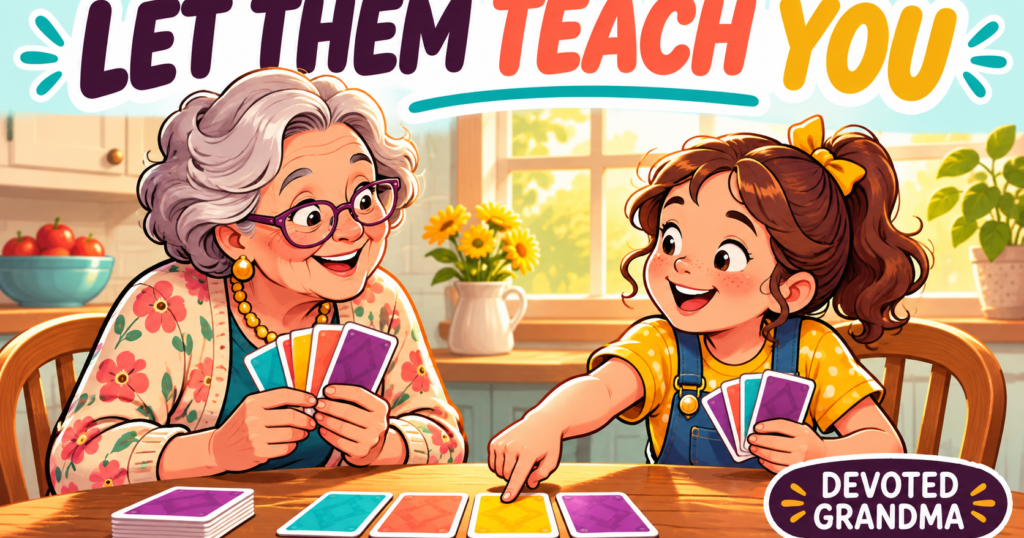
Instead of choosing an activity for your grandchild, you invite them to show you something they already enjoy. It might be a card game, a board game, a make-believe adventure, or a suitable video game their parents allow.
You do not need to become an expert. You only need to be a willing learner for a little while.
Let your grandchild choose
Begin with an invitation, not an assignment.
You might say, “Is there a game you enjoy that you’d like to teach me?”
If they are unsure, offer a few broad choices: “It could be a card game, a board game, a pretend game, or something you play on a screen.”
Then let them decide whether they want to do it at all. A grandchild who declines is not rejecting you. They may be tired, absorbed in something else, or simply uninterested in teaching that day.
You can answer warmly: “That’s all right. We can do something else.”
Leaving room for a no keeps the invitation light. It also helps prevent a fun idea from becoming another thing your grandchild has to do to please Grandma.
Ask for the first step, not every rule
Once the game begins, it may be tempting to ask several questions at once. That can leave a young teacher wondering where to start.
Try one small question instead:
- “What do I do first?”
- “Can you show me one turn?”
- “What should I pay attention to?”
- “Would you do that part again?”
Watch their demonstration before asking the next question. If the explanation is complicated, you can say, “Let me try one round, and you can help me as we go.”
This makes the game easier to learn without taking the teacher’s place away from your grandchild.
Be interested without pretending to be helpless
Your grandchild may enjoy knowing more than you do, but you do not have to act confused or make yourself look foolish. Genuine attention is enough.
You can notice something specific:
- “You explained that clearly.”
- “Now I see why you chose that move.”
- “There’s more strategy in this than I expected.”
- “I like the way everyone gets a different choice.”
These responses show that you are paying attention to what matters to them. They also keep the conversation focused on the shared experience, rather than turning it into a grand performance about how clever either person is.
If you make a mistake, keep it cheerful and ordinary: “Whoops, I skipped a step. Show me where I went wrong.”
You are not pretending incompetence. You are showing that a mistake does not have to spoil the moment.
Keep the game short enough to stay fun
A game does not need to fill the whole afternoon to be worthwhile. One round may be plenty, especially if the rules are new or either of you is getting tired.
You might say at the beginning, “Let’s try this for about fifteen minutes, and then we can decide whether to keep going.”
That gives both of you an easy stopping point. If you are having fun, continue. If the energy has faded, finish kindly:
“Thank you for teaching me. I liked seeing why you enjoy it.”
You do not need to keep score unless scoring is part of the fun for both of you. The real point is the time spent following your grandchild’s lead.
Adjust the invitation for their age
With younger grandkids
A young child’s “game” may have changing rules. The stuffed bear might be the doctor in one minute and the bus driver in the next.
Instead of correcting the story, ask, “What happens now?” or “Who should I be?”
If you need help keeping up, repeat what you understand: “So I’m bringing the bear to the store, and you’re in charge of the bus. Is that right?”
The game may not make perfect sense to you. You can still join sincerely.
With older grandkids and teens
A teen may choose a game with unfamiliar controls, detailed rules, or words you do not recognize. Let them explain without joking that their interests are strange or impossible to understand.
Try, “Show me the part you like best,” or “What makes someone good at this?”
Those questions give them something more interesting to share than a long list of instructions.
If they choose a video game, check with their parent about screen-time and content rules. You can enjoy their interest while respecting the limits already in place.
Make it work by phone or video
You can also let a grandchild teach from a distance.
On a video call, they might demonstrate a simple card trick, guide you through a drawing game, or explain a game while pointing the camera toward the board or screen. On a regular phone call, try a word game, guessing game, or a simple game that needs no shared pieces.
Ask ahead of time whether you need anything common, such as paper, a pencil, or a deck of cards. Avoid turning the activity into a shopping list. If you do not have the right item, ask, “Is there another version we can play with what we have?”
If hearing, vision, hand movement, reading, or technology makes one game difficult, choose another way to participate. Your grandchild might describe the action while you make a decision, move the pieces for both of you, or select a game with fewer steps. The best adjustment is the one that lets both of you take part comfortably.
Notice what happens after the game
The loveliest part may come when the game is over. Your grandchild might explain a favorite character, recall a funny round with a friend, or ask whether you want to play again next time.
Let that conversation develop naturally. You do not need to quiz them about what they learned or turn the game into a lesson.
If you enjoy simple, low-pressure ways to talk, sharing a small win with your grandchild offers another gentle opening. And if you want visits to feel easier for them, these reminders about what grandkids should never have to worry about at Grandma’s can help.
When you let your grandchild teach, you give them a turn to choose the pace, explain what matters, and welcome you into a small corner of their world.
All you have to do is ask, listen, and play.