
Disclaimer: Devoted Grandma is reader-supported. If you purchase anything through my site, I may receive a small commission (at no cost to you). Thank you.
You ask your grandchild how school went.
“Fine.”
You suggest watching a movie together.
“Whatever.”
You ask whether they would like to come over Saturday.
“Maybe.”
Grandchildren can fit an impressive amount of uncertainty into one small word. The trouble is that the same word can carry several completely different meanings.
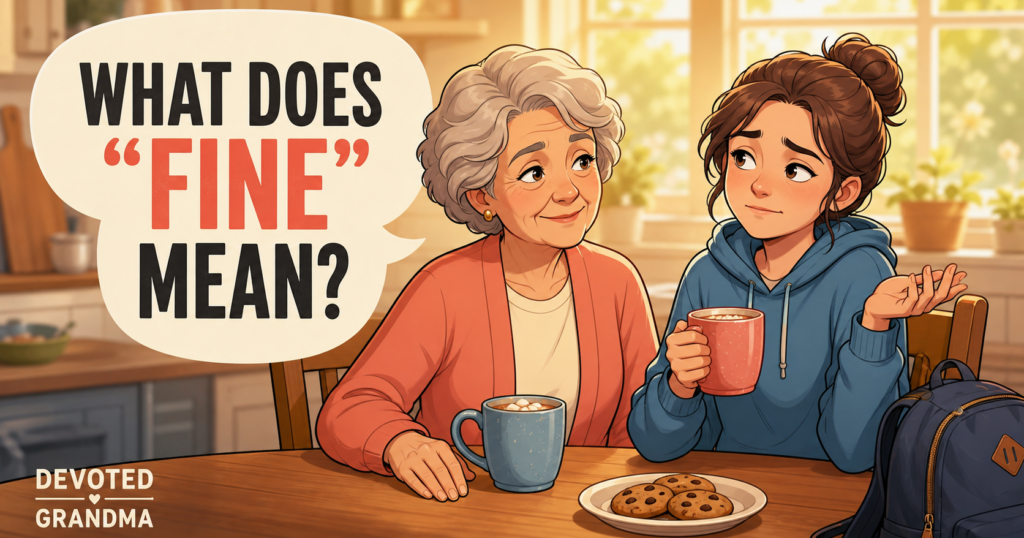
“Fine” may mean everything is perfectly fine. It may also mean, “I had a difficult day, but I do not know how to explain it yet.” The word alone cannot tell us which one is true.
That is why this is not really a translation guide in the mind-reading sense. It is a guide to staying curious, noticing context, and choosing a response that leaves the door open without pushing a grandchild through it.
1. “Fine”
Possible translation: “Nothing important happened.”
Sometimes fine really does mean fine. A cheerful voice, relaxed face, and quick return to another activity may tell you there is no hidden chapter waiting to be uncovered.
A gentle response: “Good. I’m glad to hear it.”
Then move along. Not every ordinary answer needs a full family investigation.
Another possible translation: “Something happened, but I’m not ready to talk.”
You might notice a quieter voice, a shrug that seems heavier than usual, or a change from your grandchild’s normal behavior. Those clues do not prove something is wrong, but they may suggest that a little warmth would help.
A gentle response: “All right. If there’s more you want to tell me later, I’m here.”
This response does two useful things: it accepts the answer and keeps the invitation open. If your grandchild begins to share and then hesitates, these phrases that help a grandchild feel safe telling the truth can help you continue calmly.
2. “Whatever”
Possible translation: “I truly do not have a preference.”
If you have offered pizza or sandwiches and your grandchild is happily tying a shoe while answering, “Whatever,” you may not be facing an emotional mystery. You may simply have been appointed lunch chairwoman.
A gentle response: “Sandwiches it is. You can choose the chips.”
A small choice can invite participation without turning lunch into a lengthy negotiation.
Another possible translation: “I’m frustrated and want this conversation to end.”
Tone and timing matter here. “Whatever” after a disagreement sounds different from “whatever” in response to a snack choice.
You do not have to ignore a disrespectful tone. You can protect the relationship and set a boundary at the same time.
A gentle response: “You sound frustrated. We can pause, but I still expect us to speak kindly to each other.”
That is steadier than replying with sarcasm or demanding an immediate explanation. If the voice has already risen, this article about what to do when a grandchild raises their voice offers a thoughtful way to balance calm and respect.
3. “Maybe”
Possible translation: “I want to say yes, but I do not know what else is happening.”
Older grandchildren may be waiting to hear about homework, sports, a parent’s plans, or an invitation from a friend. “Maybe” may be the most honest answer they can give at that moment.
A gentle response: “That’s fine. Let me know by Friday, and if it doesn’t work, we’ll try another time.”
A clear deadline removes uncertainty while giving them room to check.
Another possible translation: “I do not want to disappoint you by saying no.”
This can be hard for a loving grandmother to hear. A grandmother’s enthusiasm may accidentally make a simple invitation feel like a test of love.
A gentle response: “You can say no if you’d rather not. I’ll still be glad I asked.”
When a grandchild learns that “no” will be received graciously, future yeses can feel more genuine.
4. “I Don’t Know”
Possible translation: “I have not figured out what I feel.”
Adults sometimes need time to name a feeling, and children do too. “I don’t know” may be uncertainty rather than avoidance.
A gentle response: “That’s okay. You don’t have to have the words yet.”
You might then do something side by side: wash berries, take a walk, work on a puzzle, or ride in the car. Conversation can feel easier when eye contact is not the main event.
Another possible translation: “I think you may not like my answer.”
If fear or embarrassment seems possible, avoid firing off several questions. Try one calm reassurance and wait.
A gentle response: “I care more about understanding than hearing a perfect answer.”
Only say this if you are prepared to listen without immediately interrupting or lecturing.
5. “Nothing”
Possible translation: “It was a small thing, and it has already passed.”
Not every sigh is a summons. Your grandchild may have lost a round of a game, remembered an unfinished chore, or simply felt tired for a moment.
A gentle response: “Okay.”
Yes, sometimes the entire wise-grandmother response is one word.
Another possible translation: “Something is bothering me, but asking again right now will not help.”
If the moment feels heavier, add a quiet invitation.
A gentle response: “You don’t have to talk now. Would you like company, a little space, or a snack?”
Specific choices can be easier to answer than “What’s wrong?” They also offer comfort without requiring disclosure as the price of receiving it.
Notice the Whole Moment, Not Just the Word
A one-word answer becomes clearer when you gently consider what surrounds it.
- Does the tone sound relaxed, playful, irritated, or unusually flat?
- Is this typical for your grandchild, or a noticeable change?
- Did the answer follow a disagreement, a busy day, or an uncomfortable question?
- Are they still staying near you, or are they clearly trying to leave?
- Do they seem more comfortable talking while doing something else?
These are clues, not proof. A crossed arm does not come with a certified translation, and one grandchild’s “fine” may sound completely different from another’s.
When uncertain, choose a response that is both kind and easy to decline: “I’m here if you want to talk,” or, “Would you like me to listen, help, or give you a little room?”
When Space Is the Loving Answer
A close bond does not require a grandchild to tell Grandma everything immediately. Sometimes a child genuinely wants privacy. Sometimes they need to speak with a parent first. Sometimes they are tired and simply have no conversation to offer.
You can say, “All right. I’ll give you some space, and I’m nearby if you need me.” Then honor what you said. Avoid following them with new versions of the same question or using guilt to pull an answer out of them.
Of course, ordinary privacy is different from a situation in which a child appears to be in immediate danger or tells you someone is hurting them. That calls for prompt help from a responsible adult who can protect them.
Most of the time, however, the best translation is not a clever interpretation. It is a simple message delivered through patience: You do not have to explain yourself perfectly to be loved, and the door will still be open when you are ready.



