Disclaimer: Devoted Grandma is reader-supported. If you purchase anything through my site, I may receive a small commission (at no cost to you). Thank you.
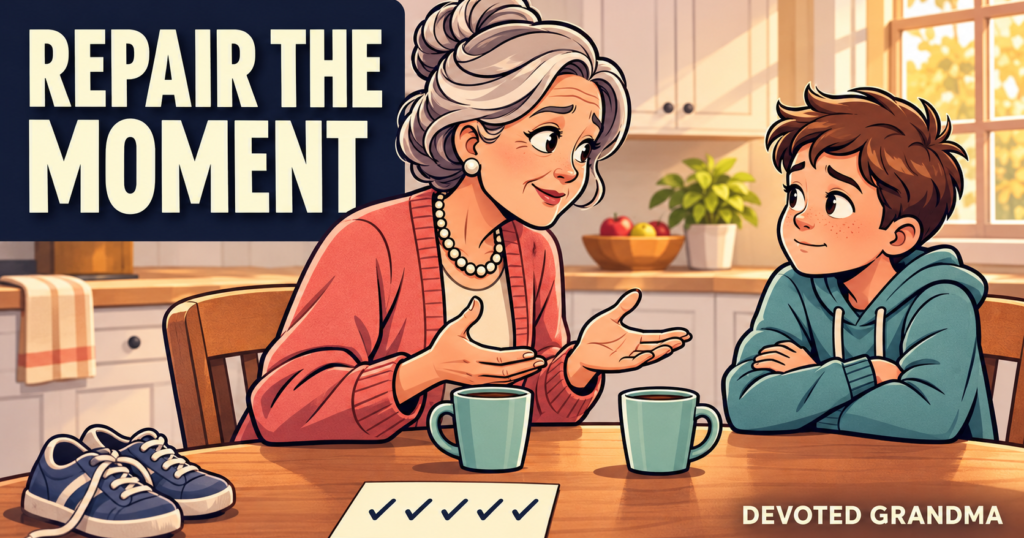
You asked your grandchild to put away a game, find their shoes, or listen while you were speaking. They did not respond as quickly as you hoped, and your voice came out sharper than you intended.
Now the room feels different.
You may want to explain that you were tired, worried, or already running late. Those things may be true. But the first repair does not need a long explanation. It needs a clear acknowledgment of what you did and a safe way for your grandchild to respond.
Here is one completed example:
“I spoke sharply to you when you could not find your shoes. That was not respectful, and I am sorry. I am going to slow down and help you look. You do not have to tell me it is okay.”
This takes less than five minutes. It names the moment, apologizes without an excuse, offers a fitting repair, and does not ask the child to comfort Grandma.
The five steps are simple: pause, name it, apologize, repair, and reconnect.
1. Pause before you explain
Take one quiet breath and lower your voice. If you are still too upset to speak kindly, say, “I need a minute to settle down. I will come back and talk with you.” Then come back as promised.
The pause is not silent punishment. It is a brief stop that keeps one impatient moment from becoming a longer argument.
Try not to begin with, “I am sorry, but you were not listening.” The word but turns the apology into another correction. There may be a separate conversation later about rules, behavior, or safety. Repair your part first.
If you often rush into advice, The Three-Minute Pause Before Grandma Gives Advice offers another way to slow down and listen before responding.
2. Name exactly what happened
A useful apology is specific. Name your action without deciding how your grandchild felt.
- “I interrupted you twice while you were trying to answer.”
- “I rolled my eyes when you changed your mind.”
- “I raised my voice because we were running late.”
- “I dismissed what you were telling me.”
Avoid dramatic statements such as, “I am the worst grandma in the world.” A grandchild may then feel responsible for reassuring you. Keep the attention on the behavior that needs repair, not on getting relief from your guilt.
You also do not need to claim an emotion you cannot know. “I embarrassed you” may be accurate, but “I spoke about that in front of other people when it should have been private” is clearer and leaves room for your grandchild’s own experience.
3. Apologize briefly and plainly
A short apology is often easier to trust than a speech.
“I was impatient and spoke disrespectfully. I am sorry.”
You can add, “You did not deserve to be spoken to that way.” Then stop. Give your grandchild room to answer, remain quiet, or continue what they were doing.
Do not require “I forgive you,” a hug, or an immediate return to cheerfulness. A sincere apology is something you offer. It is not a request for your grandchild to erase the moment on your schedule.
This same principle matters in older family relationships. The Apologies Our Adult Children May Still Need From Us explores how listening and accountability can matter even years later.
4. Make one proportionate repair
Choose a repair that fits what happened. Do not make a grand gesture for an ordinary impatient moment. Show, in one small way, what you will do differently.
- If you interrupted, invite them to finish: “I cut you off. I am ready to listen if you still want to tell me.”
- If you rushed a younger child, help with the next task instead of continuing to scold.
- If you dismissed a teen’s preference, ask whether they want to explain it again.
- If you criticized an adult grandchild in front of others, apologize privately and do not repeat the comment.
- If it happened by phone or video call, send a short message if they do not want another call right away.
The repair is not a reward for accepting your apology. It is your next responsible action.
5. Reconnect without forcing it
After apologizing, offer a gentle opening rather than demanding closeness.
With a young grandchild, you might say, “Would you like me to sit with you, or would you like a little space?”
With a teen: “You do not have to talk now. I am here when you are ready.”
With an adult grandchild: “I understand if you need time. I wanted to take responsibility without asking you to make me feel better.”
For a long-distance grandchild, a message might read:
“I have been thinking about our call. I interrupted you and sounded dismissive. I am sorry. You do not need to reply right away. If you want to finish telling me later, I will listen.”
Your grandchild may reconnect immediately, later that day, or after more time. Respecting that space is part of the repair.
When the problem is bigger than impatience
This five-minute plan is for ordinary moments such as snapping, interrupting, dismissing, or using a sharper tone than you intended. It is not enough for threats, physical harm, repeated cruelty, ongoing unsafe behavior, or a pattern that leaves a child afraid.
If a child may be unsafe, involve the parent or responsible caregiver promptly. Serious or repeated behavior may also require help from a qualified professional. An apology matters, but it does not replace protection, changed behavior, or appropriate support.
A repair does not require perfection
Loving grandmothers can still become impatient. The important question is what happens next.
You can pause. You can name what you did without hiding behind your intentions. You can apologize without asking your grandchild to soothe you. Then you can make one fitting repair and leave the door open for connection.
Five honest minutes cannot undo every hurt. They can show your grandchild something valuable: Grandma takes responsibility, their feelings are not a burden, and love is strong enough to include a sincere apology.