Disclaimer: Devoted Grandma is reader-supported. If you purchase anything through my site, I may receive a small commission (at no cost to you). Thank you.
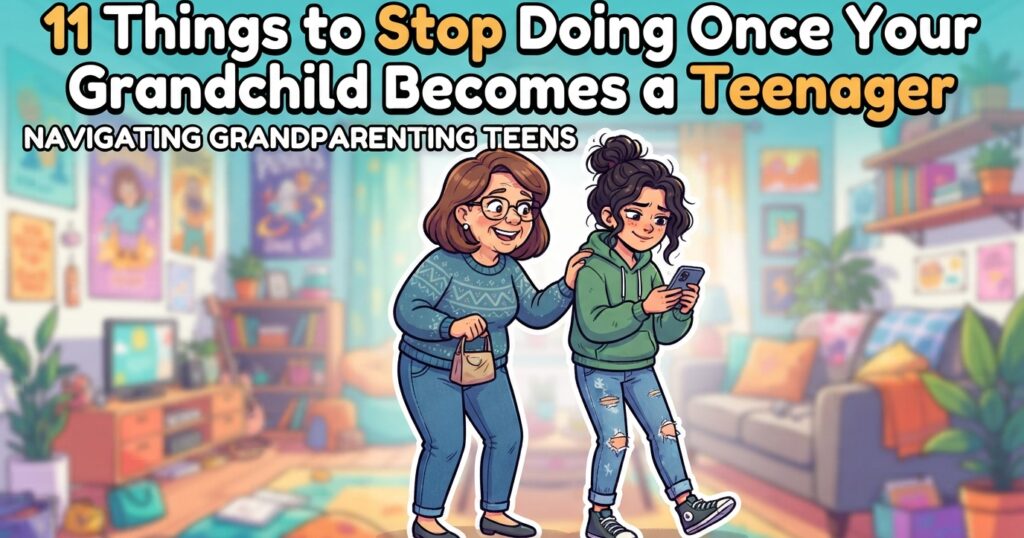
There is something strange about watching a grandchild become a teenager.
One minute, they are running through your front door asking what snacks you have. The next, they are taller than you, disappearing into their room with headphones on, and answering perfectly reasonable questions with “I don’t know.”
It can feel like your sweet, chatty grandchild has suddenly changed the rules without giving Grandma the new rulebook.
But becoming a teenager doesn’t mean they need you less. Often, they simply need you differently.
Teenagers are figuring out who they are, what they believe, how much independence they can handle, and where they fit in the world. Grandma can still be one of the safest and most important people in that journey.
Sometimes, though, keeping that closeness means letting go of habits that worked beautifully when they were younger.
Here are 11 things worth leaving behind once your grandchild becomes a teenager.
1. Stop Treating Them Like They’re Still Eight
It is surprisingly easy to freeze our grandchildren at the age we remember most fondly.
You may still see the little child who wanted to hold your hand crossing the street. But your 15-year-old probably doesn’t want to be spoken to in the same voice, given the same rules, or entertained in the same way.
Let your relationship grow with them.
Ask their opinions. Include them in adult conversations when appropriate. Give them responsibilities. Talk to them about what is happening in the world.
You haven’t lost the little child you loved. You are simply getting to meet the next version of them.
2. Stop Asking Questions the Second You See Them
“How’s school?”
“Who are you hanging out with?”
“Are you still friends with Emma?”
“How are your grades?”
“Do you have a boyfriend yet?”
Grandma, give the poor teenager a chance to put their bag down!
We often ask questions because we are genuinely interested. But teenagers can experience a rapid string of questions as an interrogation.
Try simply enjoying their presence first.
Say, “I’m so happy to see you.”
Offer them something to eat. Tell them something funny that happened to you. Let the conversation develop naturally.
You may discover that they tell you far more when you stop trying so hard to get information out of them.
3. Stop Sharing Their Business With Everyone
When grandchildren are little, we might casually tell friends and relatives everything.
“Lucy lost another tooth!”
“Ben got the lead in his school play!”
But teenagers become much more protective of their personal lives.
Their friendship problem, embarrassing school moment, first crush, disappointing grade, or emotional conversation with Grandma may not be something they want discussed at the next family gathering.
If your grandchild tells you something personal, treat it carefully.
Obviously, if their safety is at risk, you may need to involve a parent or another responsible adult. But ordinary teenage confidences deserve respect.
Being known as the grandma who can keep something private is incredibly valuable.
4. Stop Teasing Them About Crushes
“Ooooooh, is that your boyfriend?”
“Someone has a crush!”
“Look at you blushing!”
It may seem completely harmless to adults.
To a teenager, it can be mortifying.
Romantic feelings are new territory, and many teenagers are extremely self-conscious about them. Constant teasing can teach your grandchild to simply stop telling you anything about that part of their life.
If they mention liking someone, resist the temptation to turn it into a family comedy routine.
Stay calm.
Listen.
You want them thinking, I can talk to Grandma about this, not, I am never telling Grandma anything again.
5. Stop Commenting on Their Body
“You’ve gotten skinny!”
“You’re filling out!”
“You’ve put on a little weight.”
“You’re getting curves!”
“You’re going to be so tall!”
Even comments meant as compliments can make teenagers uncomfortable.
Their bodies are changing quickly enough without feeling as though every adult is inspecting the results.
Compliment things they have more control over instead.
Their kindness. Their humor. Their creativity. Their determination. Their style. Their effort.
A teenager who feels comfortable around Grandma should not have to wonder whether their body will become the topic of conversation when they walk through the door.
6. Stop Expecting Them to Tell You Everything
When they were younger, you might have known everything.
What happened at school? Who was their best friend? What upset them? What they wanted for Christmas. Who annoyed them at lunch?
Teenagers naturally begin creating a private inner world.
That can be difficult for a grandmother who once knew every little detail.
But privacy isn’t necessarily rejection.
You can say, “You don’t have to tell me, but I’m here if you ever want to.”
Then mean it.
Sometimes the strongest relationship with a teenager is built not by demanding access, but by making sure the door is always open.
7. Stop Giving Advice Before You’ve Finished Listening
Teenager: “My friend did something that really upset me.”
Grandma: “Well, what you need to do is”
Wait.
Sometimes they aren’t asking for a solution.
They are asking for somewhere safe to put their feelings.
Before offering advice, try asking:
“Do you want my opinion, or do you just need me to listen?”
That little question can completely change a conversation.
And when they do ask for Grandma’s advice, it suddenly carries much more weight because they know it wasn’t forced on them.
8. Stop Comparing Them to Other Teenagers
“Your cousin already has a part-time job.”
“Your brother never struggled with math.”
“When your mother was your age…”
Comparison rarely creates the motivation adults hope it will.
More often, teenagers hear something very different:
Someone else is better than me.
Your grandchild is developing at their own pace.
One teenager may be confident at 14. Another finds their confidence at 19. One knows exactly what career they want. Another changes their mind six times.
Encourage progress without turning someone else’s life into the measuring stick.
9. Stop Assuming Their Problems Are Small
Teenage problems can look tiny through adult eyes.
A friendship ended.
They weren’t invited somewhere.
Someone posted something mean online.
They didn’t make the team.
The person they liked doesn’t like them back.
We know life will go on.
They don’t know that yet.
So avoid saying, “You’ll laugh about this someday,” or “That’s nothing compared with real problems.”
For them, it may feel enormous right now.
You don’t have to pretend every teenage crisis is the end of the world. Simply acknowledge the feeling behind it.
“That sounds really painful.”
Sometimes that is all they need.
10. Stop Trying Too Hard to Be the “Cool Grandma”
You don’t need to know every piece of teenage slang.
You don’t need to understand every social media trend.
And you definitely don’t need to start saying words your grandchild has begged you never to say again.
Teenagers usually don’t need Grandma to become another teenager.
They need Grandma.
Your stories. Your humor. Your wisdom. Your recipes. Your perspective. Your traditions. Your slightly outdated expressions that make them roll their eyes.
Be interested in their world without pretending it is naturally your world too.
There is something wonderfully comforting about having a grandmother who is unapologetically herself.
11. Stop Taking Every Bit of Distance Personally
This may be the hardest one.
Your grandchild might stop calling as often.
They may choose friends over spending Saturday afternoon with Grandma.
They may become quieter.
Hugs might become shorter.
Your texts might occasionally receive the deeply touching teenage response:
“k”
It hurts sometimes.
But growing independence is part of adolescence.
Don’t respond by making them feel guilty.
Instead of “I suppose you’re too busy for your grandmother these days,” try:
“I know you’ve got a lot going on. I’m always happy when I get to see you.”
That difference matters.
One creates obligation.
The other creates a place they will want to return to.
Your Relationship Isn’t Disappearing, It’s Changing
The teenage years don’t have to be the years when Grandma and her grandchild drift apart.
They can actually become some of the most meaningful years of your relationship.
But the closeness may look different.
Perhaps they don’t climb onto the sofa beside you anymore, but one night they call because something has gone terribly wrong with a friend.
Perhaps they don’t want you walking them into school anymore, but they quietly ask what you think about the college they’re considering.
Perhaps they don’t tell you everything, but they tell you the things they aren’t comfortable telling anyone else.
That’s a different kind of closeness.
And it is something worth protecting.
So as your grandchild grows, allow your grandmothering to grow too.
Give a little more privacy.
Ask before advising.
Listen longer.
Judge less.
Keep the snacks.
Keep the humor.
Keep your door open.
And above all, make sure your teenager knows one thing hasn’t changed at all:
They never have to outgrow Grandma’s love.