Disclaimer: Devoted Grandma is reader-supported. If you purchase anything through my site, I may receive a small commission (at no cost to you). Thank you.
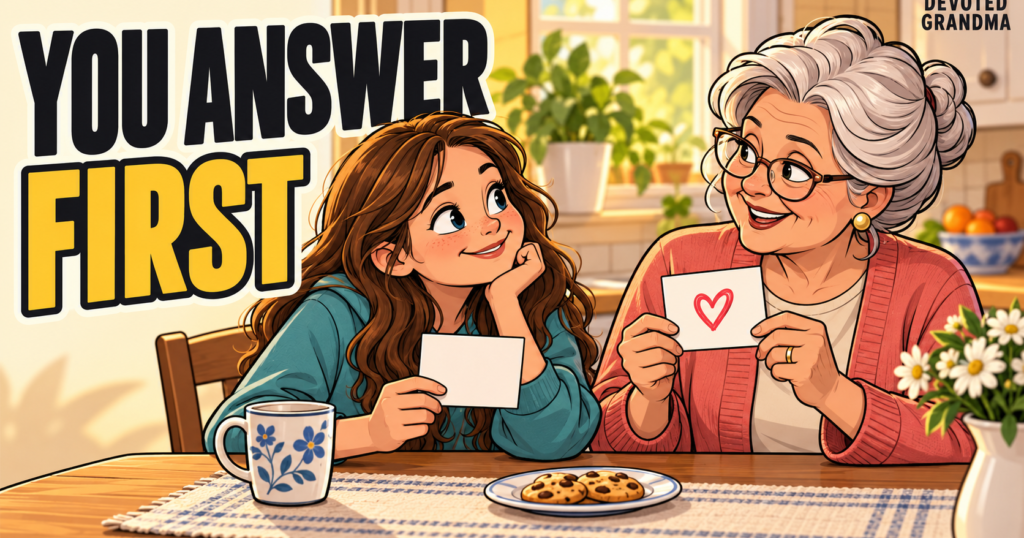
Imagine Grandma and her 14-year-old granddaughter sitting at the kitchen table after lunch.
Grandma asks, “What is one small thing that made this week better?” Then, instead of waiting, she answers: “For me, it was hearing from an old friend on Tuesday. We only talked for ten minutes, but I felt cheerful all afternoon.”
She adds, “How about you? You can answer, choose a different question, or pass.”
Her granddaughter thinks. “We had a substitute in science, so we got extra time to finish our project.”
“That sounds like good timing,” Grandma says. “What are you making?”
That is the entire answer-first pattern: choose a safe question, give your own brief answer, offer the question without pressure, and receive whatever comes next. It feels less like an interview because Grandma is not asking her grandchild to take all the emotional risk. She is joining the conversation, too.
Choose a question that is easy to hold
A good opening question does not demand a secret, confession, or full report about school. It lets a grandchild offer a little, a lot, or nothing. Choose one question that suits the moment. These six families provide variety without turning the exchange into an interrogation.
- A small bright spot: “What is one little thing that made today better?”
- A recent discovery: “What is something interesting you learned or noticed lately?”
- A simple preference: “What snack, song, or way to relax have you been enjoying?”
- A manageable challenge: “What was harder than you expected this week?”
- A choice: “Would you rather have an extra free hour in the morning or at night?”
- Looking ahead: “What is one thing you would like to do before this month ends?”
Avoid starting with loaded subjects such as grades, dating, family conflict, or behavior. If your grandchild introduces something personal, handle that trust carefully. These personal things that are not Grandma’s to share offer a useful privacy reminder.
Answer honestly without oversharing
Your answer demonstrates the exchange you are inviting. Make it truthful enough to feel real, but not so heavy that your grandchild must comfort you or solve an adult problem.
For “What was harder than you expected?” Grandma might say, “I had trouble learning a new feature on my phone. I felt impatient, so I put it down and tried again after supper.” That answer names a feeling and gives context without becoming a long complaint.
For a young child, try something concrete: “I dropped a basket of clean socks, and picking them up was harder than I expected.” With an older grandchild, you might say, “I felt nervous before making an important phone call, even though I knew it needed to be done.”
Two or three sentences are usually enough. Choose a lighter example if your answer involves someone else’s private business, unresolved conflict, money worries, detailed health concerns, or anything that could make your grandchild feel responsible for you.
Invite without pressure
After answering, hand the question over gently:
“How about you? You can answer that one, change it a little, or pass.”
Permission to pass must be real – not a polite phrase followed by coaxing. If your grandchild says, “I don’t know,” reply, “That’s all right. We can leave it there.” If they ask for another option, offer one, but do not fire off three replacement questions.
A pause may give them time to think, but silence does not have to be filled. Return to your snack, walk, puzzle, or drive together. A grandchild who passes today may remember that you respected the answer.
Respond without correcting
When your grandchild responds, resist the urge to improve the answer. If the week’s best moment was playing a video game, Grandma need not suggest that family dinner should have mattered more. If the child describes a problem, she does not have to deliver an immediate lesson.
Begin by receiving what was offered:
- “I can see why that stood out.”
- “That sounds exciting.”
- “I’m glad you told me.”
- “Would you like me to listen, or help you think about it?”
Curiosity is welcome, but connect it to the answer. One gentle follow-up usually feels better than a string of questions. Noticing what matters also helps a grandchild feel known; these little things grandkids hope Grandma notices can help.
Adapt it for age and distance
Young children: Use a visible choice: “Would you rather build a blanket fort or picnic outside?” Answer first with one reason. Let them point instead of explain.
Elementary-age grandkids: Ask about a small moment, favorite, or discovery. Keep your answer concrete. They can draw an answer when talking feels difficult.
Teens: Respect their independence. Do not disguise a checkup about school, friends, or plans as casual conversation. Answer plainly and allow time.
Adult grandchildren: Your answer can carry more depth, but the exchange should remain mutual. Do not turn your first answer into a hidden request for reassurance.
Long-distance grandkids: Text or record your answer before asking the question: “One thing that made my day easier was preparing supper early. What made your day easier? No need to answer if today is busy.” Do not treat a delayed response as rejection.
Nearby grandkids: Ask during an ordinary activity such as folding towels, baking, walking the dog, or riding in the car. Sitting side by side can feel easier than sustained eye contact.
Keep parents and privacy in their proper place
This pattern does not replace parents’ rules or create a private channel around them. Respect family boundaries concerning messages, visits, phones, and sensitive subjects.
Do not promise to keep every answer secret. If a grandchild describes abuse, danger, self-harm, or another serious safety concern, seek appropriate help and involve a responsible parent or guardian when safe to do so. For an immediate threat, contact local emergency services.
With ordinary personal details, ask before sharing: “Is this something I may mention to your parent, or would you rather keep it private?” Never turn a child’s answer into amusing family news.
Save one variation for later
A good conversation does not need six questions. Stop while the exchange still feels easy. If today’s question was, “What made this week better?” save “What helped you through a difficult moment?” for another day – and answer first again.
The reusable sequence is:
- Choose one safe question.
- Give your own brief, honest answer.
- Offer the same question with permission to change it or pass.
- Receive the response without correcting it.
- Save one variation for later.
You are not trying to produce disclosure on demand. You are showing that conversation can be mutual, unhurried, and safe. Sometimes your grandchild will answer warmly. Sometimes they will pass. Respecting either response is part of the exchange.
When Grandma answers first, one small question can become an invitation instead of an examination.