
Disclaimer: Devoted Grandma is reader-supported. If you purchase anything through my site, I may receive a small commission (at no cost to you). Thank you.
For almost thirty years, Mr. Harris owned a little store on the corner of Maple Street.
Everybody knew it.
Children stopped there after school for candy.
Parents bought newspapers in the morning.
Older neighbors came for milk, bread, batteries, birthday cards, and sometimes simply a conversation.
Mr. Harris loved his shop.
He also loved doing things exactly the way he’d always done them.
He wrote prices by hand.
He accepted cash.
He kept important numbers in a little notebook beside the register.
And every morning at exactly seven o’clock, he placed a wooden sign outside.
His daughter Emily sometimes teased him.
“Dad, you’re running a store like it’s still 1995.”
“It worked in 1995.”
“It’s not 1995.”
“Exactly. Those were better times.”
Then Maple Street began changing.
A large supermarket opened nearby.
People started ordering things online.
Fewer customers carried cash.
The newspaper deliveries became smaller.
Even the children weren’t buying as much candy because many went straight home after school.
Slowly, Mr. Harris’s shop became quieter.
Emily tried to help.
“You could take card payments.”
“Fees.”
“You could offer local deliveries.”
“I’m a shopkeeper, not a delivery driver.”
“What about putting your products online?”
Mr. Harris looked horrified.
“People know where the shop is.”
“But fewer people are coming.”
Mr. Harris didn’t want to hear it.
He had survived difficult years before.
His solution was always the same.
Work harder.
So he opened earlier.
Closed later.
Reduced his breaks.
But customers continued disappearing.
One rainy Tuesday, only six people entered the shop all day.
That evening, Mr. Harris sat behind the counter staring at the empty street.
An old customer named George came inside.
“Quiet?”
Mr. Harris sighed.
“People have changed.”
George picked up a loaf of bread.
“Yes.”
“Nobody wants things the old way anymore.”
“Seems that way.”
Mr. Harris shook his head.
“I’ve been doing this for thirty years.”
George smiled.
“And you’ve done very well.”
“So why should I have to change?”
George thought for a moment.
Then he pointed through the window.
Outside, rainwater was rushing along the gutter.
“See that water?”
Mr. Harris nodded.
“What happens when something blocks its path?”
“It goes around it.”
“Exactly.”
George placed the bread on the counter.
“Water doesn’t stop being water because it changes direction.”
Mr. Harris raised an eyebrow.
“Are you comparing my shop to a puddle?”
“I’m trying to sound wise.”
Mr. Harris laughed for the first time that day.
But George’s words stayed with him.
It doesn’t stop being water because it changes direction.
That weekend, Mr. Harris finally called Emily.
“Show me this card-payment thing.”
Emily nearly dropped her phone.
“Who are you and what have you done with my father?”
“Don’t make me change my mind.”
She came immediately.
They started small.
First, card payments.
Mr. Harris hated the machine for approximately three days.
Then he admitted it wasn’t terrible.
Next, Emily created a simple page showing what the store sold.
They began taking local orders.
Mr. Harris offered free delivery to elderly customers within the neighborhood twice a week.
Then he noticed something else.
Many local people were selling homemade products.
Bread.
Jam.
Cakes.
Crafts.
So he gave them a small section inside the store.
Suddenly, people had another reason to visit.
He added good coffee near the entrance.
He placed two little tables outside.
People started stopping again.
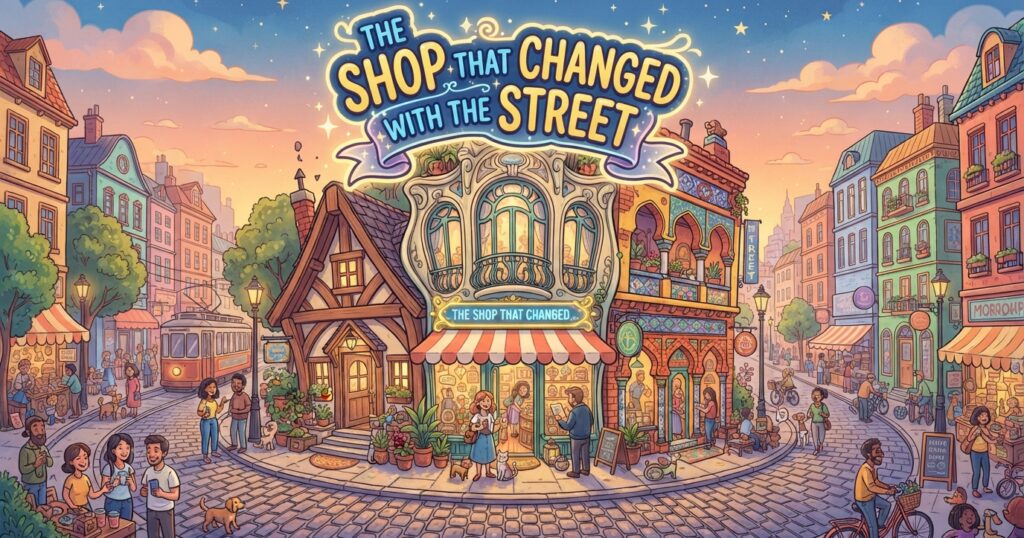
The shop was changing.
But something interesting happened.
It still felt like Mr. Harris’s shop.
He still stood behind the counter.
He still knew customers by name.
The wooden sign still went outside every morning.
The conversations remained.
The community feeling remained.
He hadn’t abandoned what made the store special.
He had simply changed the things that were preventing it from surviving.
A year later, Mr. Harris was sitting outside drinking coffee with George.
A delivery order appeared on the tablet beside him.
Mr. Harris tapped the screen.
George stared.
“Look at you.”
“Don’t start.”
“Mr. Technology.”
“I’ll throw you out.”
George laughed.
Then he looked toward the busy little shop.
“You changed quite a lot.”
Mr. Harris nodded.
“I thought changing meant admitting the old way was wrong.”
“And now?”
Mr. Harris watched Emily helping a customer.
“Now I think something can be right for one season and wrong for another.”
George smiled.
“That sounds suspiciously wise.”
Mr. Harris shrugged.
“I’ve been spending time with an old man who talks about puddles.”
Years later, Mr. Harris would tell his grandchildren that saving the shop taught him one of the greatest lessons of his life.
We often think strength means refusing to move.
Standing firm.
Never changing our minds.
Never changing our plans.
And sometimes that is strength.
But life doesn’t stay still.
Jobs change.
Families change.
Technology changes.
Relationships change.
Our bodies change.
Our plans fail.
Unexpected opportunities appear.
Doors close.
New ones open somewhere we weren’t looking.
And the people who adapt aren’t necessarily abandoning who they are.
Sometimes they’re protecting what matters most.
A tree survives a storm partly because its branches can bend.
A river reaches its destination because it can find another route.
And people survive difficult seasons because they can look at a changed situation and say:
“This isn’t what I planned. So what can I do with what I have now?”
You don’t have to change your values every time the world changes.
You don’t have to follow every trend.
You don’t have to become someone you’re not.
But don’t become so attached to one way of doing things that you lose something important simply because you refused to adjust.
Change the method.
Learn the skill.
Try the unfamiliar route.
Ask for help.
Start again differently.
Keep what matters.
Release what no longer works.
Because one of life’s greatest strengths isn’t always being strong enough to resist change.
Sometimes it’s being brave enough to change with it, and wise enough to know what should remain the same. 💛
