
Disclaimer: Devoted Grandma is reader-supported. If you purchase anything through my site, I may receive a small commission (at no cost to you). Thank you.
Eleven-year-old Lucas loved people.
Unfortunately, he loved them from approximately three inches away.
He hugged everyone.
He leaned over shoulders to see what people were doing.
He borrowed things without asking.
If his sister received a message, Lucas immediately wanted to know who sent it.
If Mom was talking quietly on the phone, Lucas somehow appeared nearby.
And if someone said, “Can I have a little space?”
Lucas usually answered,
“Why?”
His older sister, Emma, found this particularly irritating.
One afternoon, she was sitting at the kitchen table writing in a notebook.
Lucas walked over.
“What are you writing?”
“Nothing.”
He leaned over her shoulder.
“Then why are you hiding it?”
Emma quickly closed the notebook.
“Lucas!”
“What?”
“Stop reading over my shoulder.”
“I wasn’t reading.”
“You were literally reading.”
“I only saw three sentences.”
“That’s reading!”
Lucas laughed.
Emma didn’t.
She picked up the notebook and left.
Grandpa, who had been sitting nearby drinking coffee, watched the whole thing.
“Lucas.”
“What?”
“Come outside.”
Grandpa led him to the front porch.
“See Mrs. Carter’s house?”
“Obviously.”
“Go sit on her porch.”
Lucas stared at him.
“Why?”
“Just go over there and sit down.”
“I can’t do that.”
“Why not?”
“It’s her house.”
“The porch is outside.”
“Still hers.”
Grandpa nodded.
“Interesting.”
Lucas immediately realized a lesson was approaching.
“Grandpa…”
“Walk into her garden.”
“No!”
“Look through her window?”
“That’s creepy.”
Grandpa smiled.
“So you understand personal space.”
Lucas frowned.
“Houses aren’t people.”
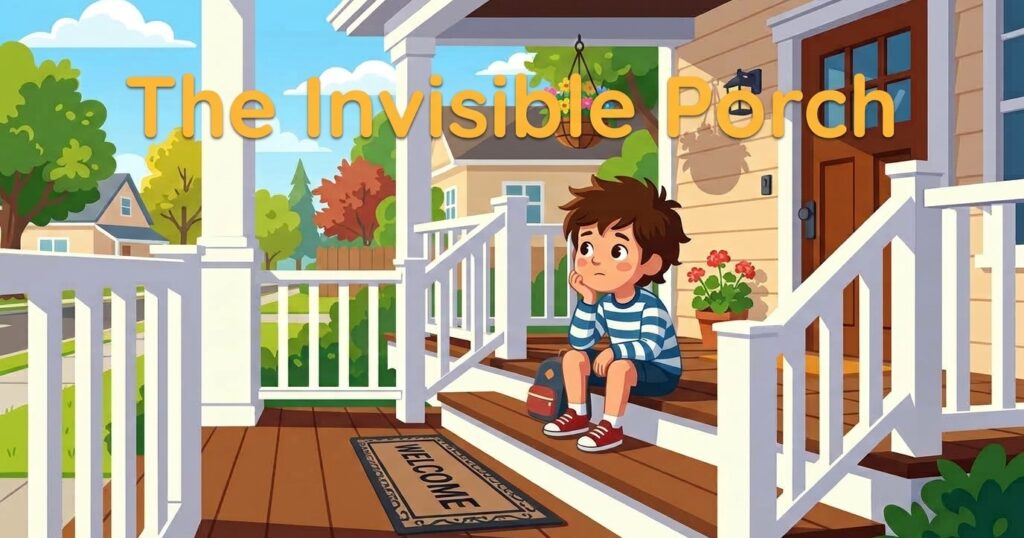
“No. But people have invisible porches too.”
Lucas looked confused.
Grandpa explained.
“There are spaces around people that belong to them. Physical space. Private conversations. Belongings. Thoughts. Feelings. Sometimes even time.”
“But how am I supposed to see an invisible porch?”
“You can’t.”
“Exactly!”
Grandpa laughed.
“That’s why you pay attention.”
He pointed toward Emma’s bedroom.
“When Emma closes her notebook, that’s a fence.”
Lucas looked toward the house.
“When someone steps backward because you’re standing too close, that’s a fence.”
Grandpa continued.
“When someone says they don’t want a hug, that’s a fence.”
“What if I know they like hugs?”
“Maybe they don’t want one right now.”
Lucas hadn’t thought about that.
Grandpa leaned back in his chair.
“Your comfort doesn’t automatically decide someone else’s comfort.”
That sentence stayed with Lucas.
The next morning, he started noticing things.
At school, his friend Ethan moved his chair slightly backward when Lucas leaned too close.
Normally, Lucas would have moved closer without thinking.
This time, he didn’t.
At lunch, a classmate had a packet of cookies.
Lucas almost reached over and took one.
Then he stopped.
“Can I have one?”
The classmate smiled.
“Sure.”
That felt surprisingly easy.
Later, Lucas saw Emma texting on the couch.
He sat beside her.
“Who are you texting?”
Emma gave him a look.
Lucas caught himself.
“Never mind.”
Emma looked suspicious.
“Are you okay?”
“I’m respecting your invisible porch.”
“My what?”
“It’s a long story.”
A few days later, Lucas learned that personal space wasn’t only physical.
His friend Ethan was unusually quiet during recess.
“What’s wrong?” Lucas asked.
“Nothing.”
“Something happened.”
“I don’t want to talk about it.”
Normally, Lucas would have kept asking.
Come on.
Tell me.
What happened?
Was it your parents?
Did you get in trouble?
Instead, he remembered Grandpa.
A fence.
“Okay,” Lucas said. “If you want to talk later, I’m here.”
Ethan nodded.
That afternoon, Ethan found him.
“My parents were arguing last night.”
Lucas listened.
He realized something important.
Giving someone space didn’t always push them away.
Sometimes it made them feel safe enough to come closer on their own.
Months passed.
Lucas remained Lucas.
He was still affectionate.
Still curious.
Still enthusiastic.
He still occasionally forgot and leaned over Emma’s shoulder.
“Porch!” she would shout.
“Sorry!”
But he became better at recognizing boundaries.
He knocked before entering bedrooms.
He asked before borrowing things.
He learned that “no” didn’t always require an explanation.
Most importantly, he stopped assuming that affection gave him automatic access to another person.
Years later, Lucas was a father.
One evening, his eight-year-old daughter came home from school looking upset.
“What happened?” Lucas asked.
“Nothing.”
“You sure?”
She nodded.
Lucas wanted to ask ten more questions.
Instead, he said,
“Okay. I’ll be downstairs if you need me.”
About twenty minutes later, she appeared beside him.
“Dad?”
“Yeah?”
“Can I tell you something?”
Lucas smiled.
“Of course.”
She climbed onto the couch.
As she began talking, Lucas thought about Grandpa’s invisible porch.
He finally understood the lesson completely.
Respecting personal space doesn’t mean becoming distant or uncaring.
It means understanding that closeness cannot be forced.
People should be allowed to decide when they want a hug.
When they’re ready to talk.
How much they want to share.
Who touches their belongings.
How close someone stands.
When they need quiet.
And sometimes, when they simply want to be alone.
Different people have different boundaries.
What feels friendly to you may feel uncomfortable to someone else.
What feels like harmless curiosity to you may feel intrusive to them.
So notice.
Ask.
Knock.
Wait.
Listen when someone says no.
And don’t take every boundary personally.
Because respecting someone’s space sends a powerful message:
I care about your comfort, not just my own.
Grandpa had been right.
Everyone has an invisible porch.
You may be welcomed onto it often.
You may even become one of the person’s favorite visitors.
But no matter how much you love someone, it’s still polite to knock before you walk in. 💛
