
Disclaimer: Devoted Grandma is reader-supported. If you purchase anything through my site, I may receive a small commission (at no cost to you). Thank you.
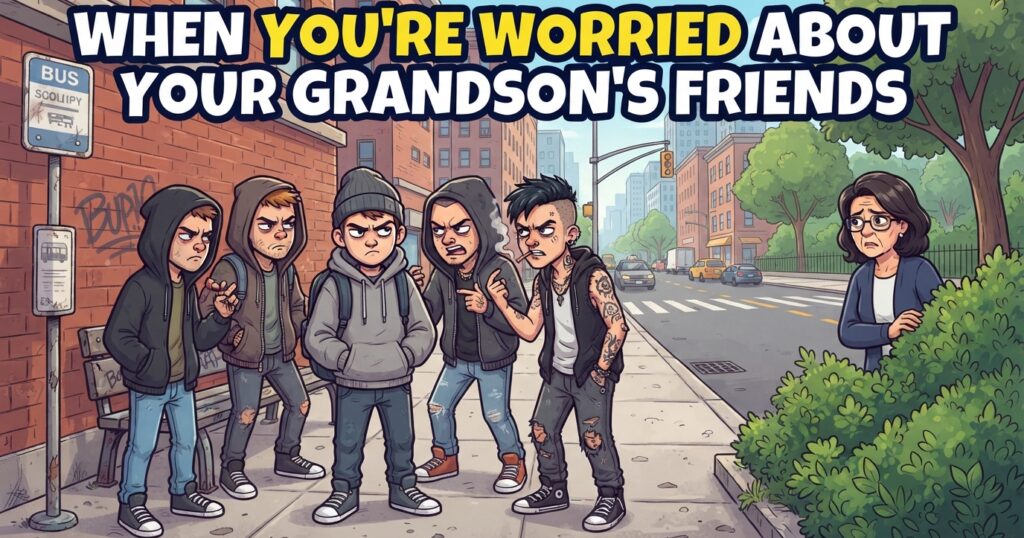
Your 14-year-old grandson, Ethan, has always been sweet and easy to talk to when he visits. Lately, though, he has started spending most of his free time with a new group of boys.
The first few times they came to your house, you tried to make them feel welcome. But you noticed things that bothered you. One boy made fun of another child at school. Another used language you didn’t appreciate. And when you asked the boys not to leave food wrappers all over the den, one of them rolled his eyes when he thought you weren’t looking.
Even more troubling, Ethan seems different around them. He acts louder, makes jokes at other people’s expense, and brushes you off in ways he never used to.
One afternoon, Ethan asks, “Grandma, can the guys come over Saturday? We want to hang out here.”
Your first instinct is to say absolutely not. You don’t want these boys influencing your grandson—or disrespecting your home.
But you also know that criticizing a teenager’s friends can sometimes make him defend them even more.
There are few things that stir up a grandmother’s protective instincts quite like watching a grandchild fall in with friends who make us uneasy.
We have lived long enough to know that friendships matter. We remember the people who brought out the best in us—and perhaps a few who brought out something quite different.
So when we notice our grandson behaving differently around certain friends, it is natural to want to intervene.
But with teenagers, how we intervene can matter every bit as much as whether we intervene.
A. Tell Ethan you don’t like his friends and explain that he shouldn’t spend time with them.
This response comes from a very understandable place.
You love Ethan. You see behaviors that concern you, and you want to steer him away from trouble before something more serious happens.
The difficulty is that teenagers often experience criticism of their friends as criticism of themselves.
At this age, friendships can become deeply tied to identity. If Grandma says, “Those boys are bad influences,” Ethan may hear, “I don’t trust your judgment.”
And once a teenager feels judged, the conversation can quickly turn into a defense of the friends rather than a thoughtful look at their behavior.
Ethan might even become more loyal to the group simply because he feels he has to prove that Grandma is wrong.
That doesn’t mean you should ignore troubling behavior. It simply means that attacking the friends directly may close a door that you would rather keep open.
B. Let them come over without saying anything because teenagers need freedom.
There is wisdom in giving teenagers room to choose their own friends.
Young people need opportunities to make judgments, experience relationships, and gradually learn what kind of people they want in their lives.
But freedom does not require a grandmother to abandon the standards of her own home.
If someone speaks cruelly, uses disrespectful language, or ignores reasonable household rules, you are allowed to address it.
In fact, calm boundaries can be reassuring to teenagers, even when they pretend otherwise.
Saying nothing might also leave Ethan unsure about what you actually value.
You do not need to lecture him, but neither do you need to pretend that behavior which concerns you is perfectly acceptable.
C. Allow them to visit, set clear expectations, and speak privately with Ethan later.
It protects two valuable things at the same time: your relationship with Ethan and the standards of your home.
You might say before the boys arrive, “Of course they can come over. I’m happy for you to have friends here. I just expect everyone in this house to speak respectfully and clean up after themselves.”
Notice what this does not say.
It doesn’t say, “Your friends are rude.”
It doesn’t say, “I don’t trust those boys.”
And it doesn’t say, “You’re becoming just like them.”
Instead, it makes the boundary about behavior.
That distinction is important.
A teenager may passionately defend a friend, but he can still recognize that a particular behavior is unkind, disrespectful, or inappropriate.
Having the boys in your home also gives you something valuable: a window into Ethan’s social world.
You can observe without spying. You can offer snacks, exchange a few friendly words, and learn what these boys are actually like.
Sometimes the child who seems rough around the edges turns out to be funny, loyal, or going through difficulties of his own.
Other times, your concerns prove justified.
Either way, you will understand more by staying connected than by shutting the door.
Later, when Ethan is alone with you and things are calm, you might gently say, “I’ve noticed that when you’re with the guys, sometimes you make jokes at other people’s expense. That’s not something I usually see from you. How do you feel when everyone starts joking like that?”
Then listen.
That question invites reflection rather than demanding a confession.
The goal isn’t to force Ethan to admit that his friends are bad. The goal is to help him notice who he becomes when he is with them.
That is a much more powerful lesson.
D. Ban the friends from your home but allow Ethan to see them elsewhere.
This might feel like a sensible compromise.
You’re not telling Ethan whom he can be friends with. You’re simply saying you don’t want the boys in your house.
And there certainly may be situations where a boundary like this becomes necessary—particularly if a friend repeatedly behaves dangerously, steals, threatens someone, brings substances into the home, or refuses to follow basic rules.
But for ordinary concerns about attitude, language, or manners, banning the group may have an unintended consequence.
It moves Ethan’s friendships somewhere you cannot see them.
Your home can be one of the safest places for teenagers to gather precisely because a caring adult is nearby.
There is something wonderfully old-fashioned about a grandmother’s house becoming the place where young people know there will be food, warmth, and boundaries.
You may have more influence simply by keeping the door open.
A Grandmother’s Gentle Advantage
As grandchildren grow older, our role changes.
When they were little, we could simply say, “Don’t do that.”
Teenagers require something subtler.
We become gardeners rather than traffic police.
We plant questions.
We model values.
We set reasonable boundaries.
And then we give them room to discover what kind of person they want to become.
If you’re worried about your grandson’s friends, pay attention not only to who they are, but to who your grandson becomes around them.
Then keep the conversation warm enough that he will still come to you when friendship becomes complicated.
Because one day, Ethan may realize for himself that certain friends don’t bring out the best in him.
And when that day comes, the grandmother who listened instead of condemning may be exactly the person he chooses to talk to.



