Disclaimer: Devoted Grandma is reader-supported. If you purchase anything through my site, I may receive a small commission (at no cost to you). Thank you.
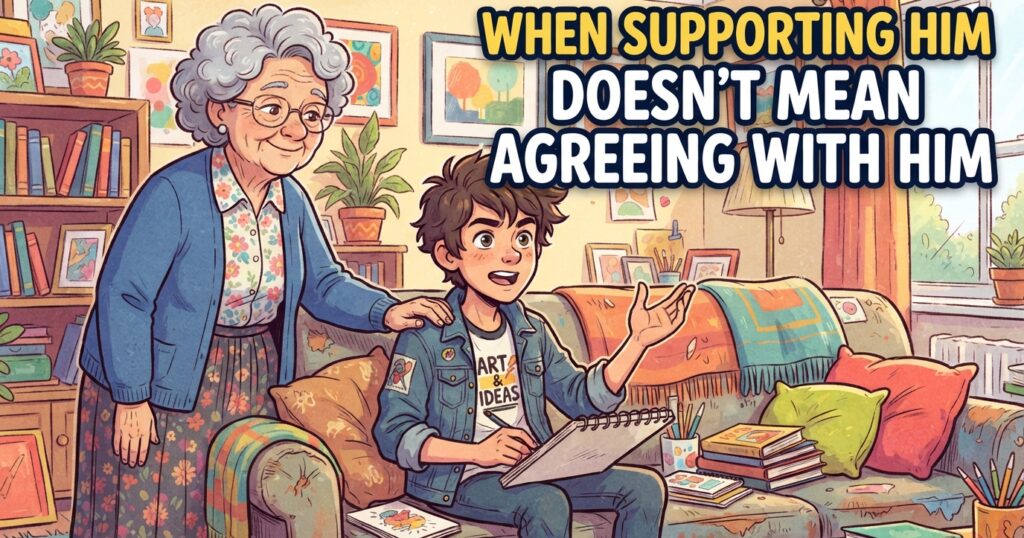
Your 15-year-old grandson, Marcus, has been upset all week.
His parents have decided that he needs to give up playing video games on school nights because his grades have slipped. Marcus thinks the rule is completely unfair. He insists that gaming helps him relax, says his parents “don’t understand anything,” and tells you that they are treating him like a little kid.
One afternoon, while the two of you are alone, he finally opens up.
“Grandma, you get it, right? This is ridiculous. Mom and Dad won’t listen to me. Can you please tell them they’re being unfair?”
You can see how frustrated he is. You also understand why his parents are concerned about his schoolwork.
Marcus looks at you hopefully, clearly wanting you to take his side.
There is something especially tender about the moment when a grandchild asks us to take his side.
When a grandson says, “Grandma, you understand me,” it can tug at the heart. We want him to know that he has someone in his corner. We want him to feel heard, protected, and loved.
But sometimes supporting a grandchild does not mean agreeing with him.
Sometimes the most loving thing we can do is help him move through a disappointment he cannot immediately change.
Let’s look at each response.
Option A: Agree with Marcus and tell him you’ll speak to his parents.
This response is very understandable.
A grandmother may think, “He came to me because he trusts me. I don’t want him to feel alone.”
And perhaps you genuinely believe the rule is stricter than necessary.
The difficulty is that stepping in immediately can unintentionally put you in the middle of the parent-child relationship.
Marcus may begin to see you as the person who can overrule or negotiate around his parents whenever he dislikes a decision. His parents, meanwhile, may feel that their authority is being undermined.
That does not mean grandparents should never speak up. There are certainly situations where a grandparent may need to raise a concern, especially if a child’s safety or well-being is involved.
But an ordinary disagreement about household rules usually gives us a different opportunity: helping a young person learn how to handle frustration respectfully.
Instead of becoming his advocate against his parents, you can become his guide.
Option B: Tell him his parents are in charge and he simply needs to accept it.
There is truth in this response.
His parents do have the responsibility to make household decisions. Marcus may not like every rule, and part of growing up is learning that we sometimes have to live with decisions we would not have chosen.
But beginning with authority rather than empathy may cause him to stop talking.
When a teenager says, “This is unfair,” he is often expressing more than an opinion about a rule.
He may be saying, “Nobody is listening to me.”
He may be saying, “I feel powerless.”
Or he may simply be trying to make sense of a disappointing limit.
If Grandma responds immediately with, “Your parents are in charge,” Marcus may hear, “Your feelings don’t matter.”
He still needs to respect the rule, but he will be more able to do that if he first feels understood.
Option C: Acknowledge his frustration, avoid taking sides, and help him talk with his parents.
This is the best response.
You might begin by saying something like, “I can see why you’re frustrated. You really enjoy gaming, and losing it during the week feels like a big change.”
Notice what you have not said.
You have not said his parents are wrong.
You have not said Marcus is right.
You have simply shown him that you understand his feelings.
That small distinction is powerful.
Children and teenagers often calm down when they feel heard. Emotional validation does not mean agreement. It means recognizing another person’s experience.
Once Marcus feels understood, you can gently help him move from anger toward problem-solving.
You might ask, “What do you think your parents are worried about?”
At first he may say, “They just want to control me.”
But with patience, he may eventually admit that his grades have slipped.
Then you can ask another question: “Is there a way you could show them that you can manage both your schoolwork and gaming responsibly?”
Perhaps Marcus could suggest a trial arrangement. Maybe he completes homework first, keeps his grades above an agreed level, or limits gaming to a certain amount of time.
His parents may still say no.
And that is important too.
Supporting him also means helping him learn that a respectful conversation does not always lead to the answer we want.
Sometimes maturity is being able to say, “I disagree, but I understand.”
That is a life skill he will use far beyond his teenage years.
Option D: Distract him and avoid the conversation.
Spending enjoyable time together certainly has value.
A walk, a card game, a favorite meal, or a bit of laughter can help a frustrated teenager reset emotionally.
But distraction alone misses an important opportunity.
Marcus came to you because something was bothering him. If you change the subject too quickly, he may wonder whether you are uncomfortable with his feelings.
Grandchildren do not always need us to fix their problems.
Often they simply need a safe place to talk them through.
And grandparents can offer something very special in those moments: perspective without pressure.
The gentle lesson for Grandma
One of the greatest gifts a grandmother can give is the ability to stand beside a grandchild without automatically standing against someone else.
You can say, in effect:
“I understand why you’re upset.”
“I’m willing to listen.”
“And I believe you are capable of handling this thoughtfully.”
That combination gives a young person both comfort and confidence.
As grandchildren grow older, we cannot smooth every disagreement from their path. Nor should we.
What we can do is teach them how to walk through disappointment, frustration, and conflict without losing their voice or their relationships.
Sometimes your grandchild will agree with you.
Sometimes he will agree with his parents.
And sometimes he will remain completely convinced that everyone else is wrong.
That is all right.
Your role is not always to change his mind.
Sometimes it is simply to help him become the kind of person who can disagree, speak respectfully, listen carefully, and still remain connected to the people he loves.
And years from now, he may not remember the rule about video games at all.
But he may remember that when he was upset, Grandma listened.