Disclaimer: Devoted Grandma is reader-supported. If you purchase anything through my site, I may receive a small commission (at no cost to you). Thank you.
Your 16-year-old grandson, Eli, is usually cheerful when he visits, but today he seems unusually withdrawn.
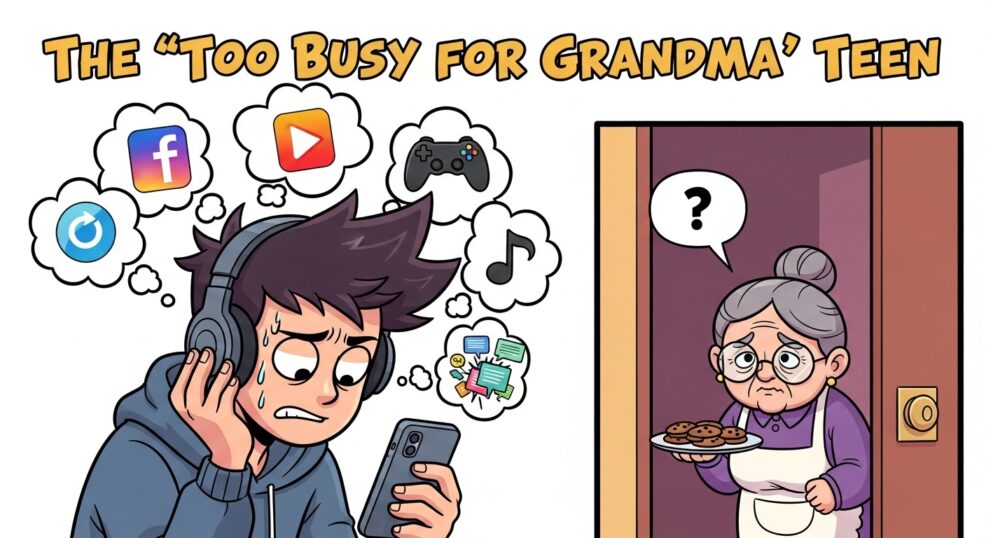
While you’re making lunch, he sits at the kitchen table scrolling through his phone. Suddenly, he sighs and puts it face down.
A few minutes later, you notice a notification light up the screen. You don’t read the whole message, but you catch a few words:
“Everyone saw it.”
Eli quickly grabs the phone and says, “It’s nothing.”
Later, he admits that someone from school posted an embarrassing video of him on social media. Other students have shared it, added laughing emojis, and made comments. He says he wants to stay home from school tomorrow.
You feel furious. Part of you wants to call the school immediately. Another part wants to tell him to ignore it and not let mean kids get to him.
But you can tell he is genuinely hurt.
Social media can make an ordinary teenage embarrassment feel enormous.
Years ago, an awkward moment might have been witnessed by a handful of classmates and forgotten within a few days. Today, a photo, video, or cruel comment can be shared with dozens—or hundreds—of people in minutes.
For a teenager, that can feel overwhelming.
It may be tempting for a grandmother to dismiss social media as “just the internet.” But to many teenagers, their online world is closely connected to their friendships, reputation, school life, and sense of belonging.
So Eli’s distress deserves to be taken seriously.
Let’s look at each response.
Option A: Tell him to leave social media
There is something understandable about this response.
When we see something hurting someone we love, our instinct is often to remove the source of the pain.
You may think, “If social media is causing this much trouble, why not simply get rid of it?”
Taking a break from social media may sometimes be helpful. But telling Eli to delete everything immediately can miss the deeper issue.
The problem is not simply that he has a social media account.
The problem is that someone humiliated him publicly.
If the first response he hears is, “Then get off social media,” he may feel as though he is being blamed for what happened.
It can also leave the harmful behavior unaddressed.
Rather than deciding for him, it is better to help him think through whether temporarily stepping away from certain apps would make him feel calmer while the situation is being handled.
Option B: Take over immediately
A grandmother’s protective instincts can become very strong when a grandchild is being mistreated.
Calling parents or the school may eventually be completely appropriate.
Cyberbullying should not be ignored, especially if threats, harassment, impersonation, or repeated targeting are involved.
But unless there is an immediate safety concern, it can help to involve Eli in deciding what happens next.
Teenagers often feel powerless when something embarrassing spreads online.
If adults immediately take control without including them, they can feel even more powerless.
A better approach is to say something like, “I think an adult may need to help with this. Let’s talk about who you would feel comfortable involving.”
There is an important exception: if Eli is being threatened, blackmailed, sexually exploited, physically endangered, or talking about harming himself, an adult should step in immediately.
Safety always comes first.
Option C: Tell him to ignore it
Many of us were raised with advice like, “Don’t let them see that they bothered you.”
There is some wisdom in not feeding every cruel comment with a reaction.
But telling a hurting teenager simply to ignore public humiliation can feel dismissive.
Eli is not weak because this bothers him.
Imagine walking into a room knowing that several people have just watched an embarrassing video of you.
Most adults would feel uncomfortable too.
Teenagers are especially sensitive to social acceptance because friendships and peer relationships become increasingly important during adolescence.
Encouraging resilience is valuable.
But resilience does not mean pretending something painful does not hurt.
It means helping a young person move through the hurt with support and perspective.
Option D: Listen, validate, and help him respond
This is the strongest response.
You begin by sitting with Eli rather than immediately solving the problem.
That tells him something very important:
“You do not have to face this alone.”
You might say, “Oh, sweetheart, that sounds terribly embarrassing. I can understand why you don’t want to walk into school tomorrow.”
That simple acknowledgment can lower the emotional temperature.
Then comes an important question:
“Do you feel safe?”
This helps distinguish an upsetting situation from a dangerous one.
Next, let Eli explain what happened.
Who posted the video?
Was it taken with his permission?
How widely has it been shared?
Are people simply laughing, or are there threats or repeated harassment?
Once you understand the situation, you can help him think about practical steps.
For example, he may be able to save screenshots as evidence, report the original post, block certain accounts, adjust privacy settings, or ask a trusted adult at school for help.
The key is doing these things with him, not simply doing everything for him.
That approach teaches a valuable lesson.
Eli learns that when something goes wrong online, he has options.
He can ask for help.
He can document what happened.
He can protect himself.
And he can make thoughtful decisions even while feeling embarrassed or upset.
Just as importantly, he learns something about you.
He learns that Grandma is not going to panic, lecture, or minimize the problem.
She is someone who can hear difficult things.
That is the kind of trust that becomes precious during the teenage years.
A grandmother’s gentle reminder
Social media may be new compared with the world many grandmothers grew up in, but the feelings underneath it are very old.
Embarrassment.
Rejection.
Fear of being laughed at.
The longing to belong.
We may not understand every app, trend, or online expression our grandchildren use.
We do not have to.
What matters most is understanding the heart of the young person sitting beside us.
When a teenager comes to us with an online problem, our first job is not to become a social media expert.
Our first job is to become a safe person.
Listen before lecturing.
Ask before assuming.
Take their feelings seriously.
And when necessary, help them bring trustworthy adults into the situation.
A teenager who knows, “Grandma will listen without making things worse,” has something far more valuable than another follower online.
He has a safe place to land.