Disclaimer: Devoted Grandma is reader-supported. If you purchase anything through my site, I may receive a small commission (at no cost to you). Thank you.
Your 11-year-old granddaughter, Lily, has always been affectionate with you. Since she was little, she would run into your arms, curl up beside you on the sofa, and happily hold your hand wherever you went.
Lately, though, something has changed.
When you arrive for a family dinner, you open your arms for your usual big hug. Lily gives you a quick half-smile, steps back slightly, and says, “Hi, Grandma.”
You feel a tiny sting.
Later, when everyone is gathered in the kitchen, you gently tease, “What happened to my little cuddle bug? Grandma doesn’t get hugs anymore?”
Lily looks embarrassed and mumbles, “I just don’t really like hugging people that much now.”
Her mother quickly changes the subject, but the moment stays with you.
You know Lily loves you. Still, you miss the closeness you once shared, and a small part of you worries that she may be pulling away from you altogether.
When Love Changes Shape
There are moments in grandparenting that catch us by surprise.
Sometimes it isn’t a big disagreement or a harsh word. Sometimes it is something very small — an unanswered phone call, a child who suddenly closes the bedroom door, or a grandchild who no longer reaches for our hand.
And goodness, those little changes can tug at a grandmother’s heart.
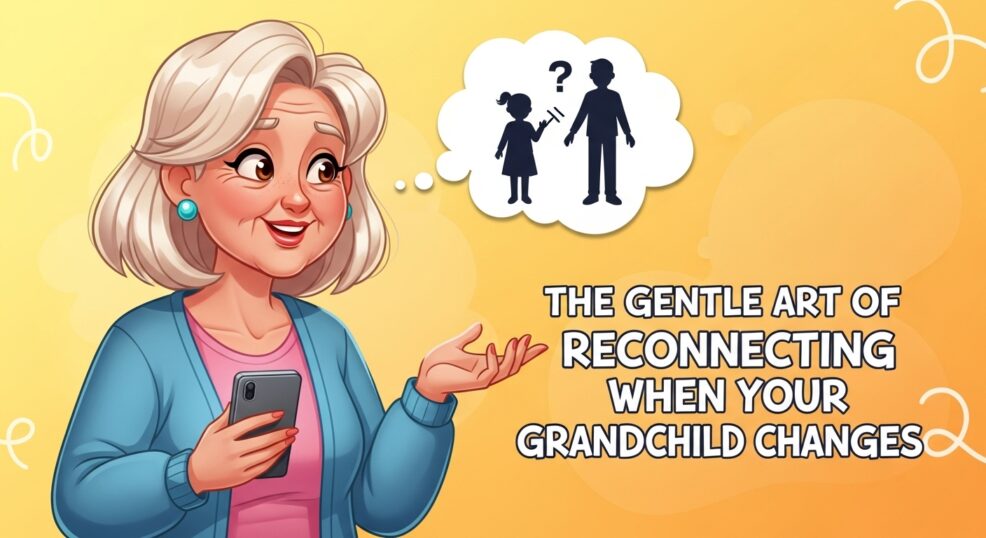
When Lily steps away from Grandma’s hug, Grandma may hear something Lily never actually said.
She may hear, I don’t need you anymore.
But Lily may simply be saying, I’m growing, and I’m figuring out what feels comfortable to me.
Those are two very different messages.
Understanding the difference can protect a precious relationship.
Option A: “Grandma won’t be around forever.”
This reaction is understandable because Grandma’s feelings are real.
She remembers the toddler who wrapped tiny arms around her neck. She remembers bedtime cuddles, kisses on scraped knees, and little hands tucked inside hers.
Losing those rituals can feel surprisingly emotional.
But telling Lily that she may regret refusing affection places a heavy emotional responsibility on a child.
Instead of learning, “My body belongs to me,” Lily may begin learning, “I need to give affection so other people don’t feel sad.”
That is not the lesson we want our grandchildren to carry into friendships, dating relationships, or adulthood.
Children benefit from learning that affection should be freely given, not owed.
Grandma can feel disappointed without asking Lily to fix the disappointment for her.
Option B: Stop initiating affection altogether.
This choice respects Lily’s wishes, which is certainly a step in the right direction.
Yet completely withdrawing warmth could accidentally communicate something Grandma never intends.
Lily might wonder:
Is Grandma upset with me?
Did I do something wrong?
Does she love me less now?
Children and preteens often experiment with independence while still needing reassurance that the relationship underneath remains steady.
Grandma doesn’t have to disappear emotionally simply because one form of affection has changed.
Connection can remain warm, playful, and loving.
A relationship can adjust without becoming distant.
Option C: Accept the boundary and offer another way to connect.
This is the strongest response.
Imagine Grandma smiling and saying:
“That’s perfectly okay, sweetheart. Would you like a high-five instead?”
What a beautiful message Lily receives in that moment.
She learns:
Grandma listens to me.
Grandma respects me.
I can tell Grandma what I need.
Her love doesn’t disappear when I say no.
Those lessons are enormously important.
Around the preteen years, many children become more aware of personal space, embarrassment, social expectations, and bodily autonomy. A child who once happily hugged everyone may suddenly prefer a wave, fist bump, shoulder squeeze, silly handshake, or simply a warm hello.
It doesn’t necessarily mean affection has disappeared.
It may simply be changing shape.
And something wonderful often happens when adults respect a child’s boundary.
The child feels safer.
And when children feel safe, they are often more willing to reconnect voluntarily.
One afternoon Lily may climb onto the sofa beside Grandma again.
Another day she may slip her arm through Grandma’s while they are walking.
Perhaps months later she will initiate a hug herself.
The important thing is that the affection becomes hers to give.
That makes it more meaningful, not less.
Option D: Keep offering hugs as usual.
This response may seem harmless.
Grandma might think, I’m only offering. She can always say no.
And occasionally offering a hug with no pressure may indeed be fine, depending on the child.
But if Lily has clearly said she does not enjoy hugging right now, repeatedly presenting the same request can become uncomfortable.
Imagine having to decline someone you love every single time you see them.
Eventually Lily may begin dreading the greeting itself.
Instead, Grandma can create a new ritual together.
Perhaps they invent a secret handshake.
Maybe Grandma taps her heart and Lily taps hers.
Perhaps they say, “Love you to the moon,” and the other replies, “And back again.”
Children often adore small traditions that belong uniquely to them and their grandparents.
Those rituals can become every bit as precious as hugs.
The Deeper Lesson
Grandparenting asks us to love someone who is constantly changing.
The three-year-old who begged us to stay may become the thirteen-year-old who wants privacy.
The child who told us every playground story may become the teenager who answers, “Nothing much.”
The little one who once climbed into our lap may suddenly decide she prefers sitting across the room.
Our instinct may be to hold tightly to the version of them we remember.
But one of the greatest gifts a grandmother can give is this:
I will love the person you are becoming, not only the child you used to be.
That kind of love creates trust.
And trust is what keeps grandchildren coming back.
When Lily says, “I don’t really like hugs now,” Grandma has an opportunity far bigger than the hug itself.
She can show Lily that boundaries do not threaten love.
She can show her that closeness does not require control.
She can show her that Grandma’s heart is spacious enough to let their relationship grow and change.
So perhaps the next greeting sounds like this:
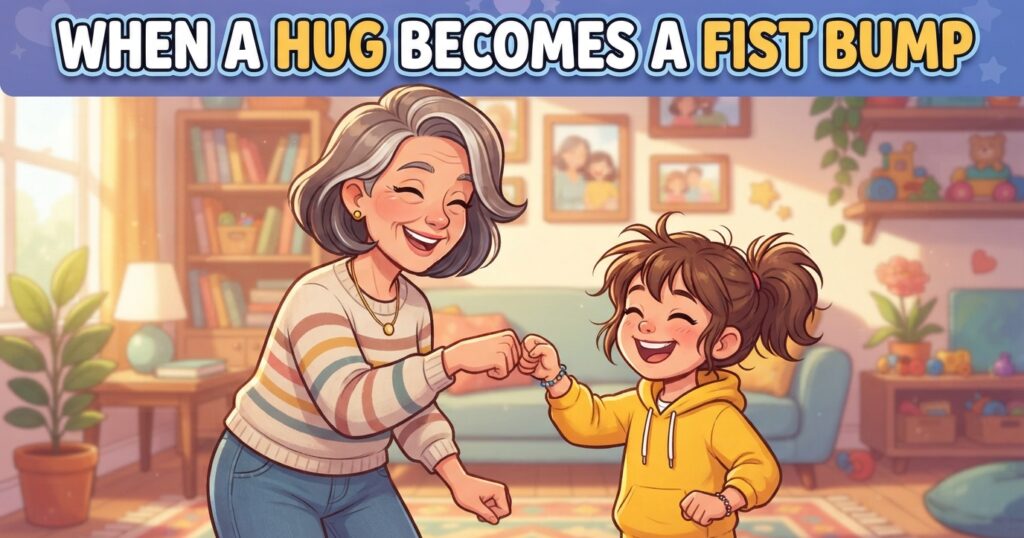
“There’s my girl! Hug, fist bump, wave, or just a hello?”
Lily smiles.
“Fist bump.”
Grandma holds out her hand.
Their knuckles meet.
And there it is, connection.
Different from before.
But still wonderfully theirs.