
Disclaimer: Devoted Grandma is reader-supported. If you purchase anything through my site, I may receive a small commission (at no cost to you). Thank you.
Every December since your children were small, your family has spent one Saturday afternoon making your mother’s special holiday biscuits.
The recipe is handwritten on a faded card, complete with a little flour smudge in one corner. Your grandchildren have grown up hearing stories about how their great-grandmother used to make the same biscuits in a tiny kitchen, humming while she rolled the dough.
To you, the afternoon has always felt like more than baking.
It is a thread connecting one generation to another.
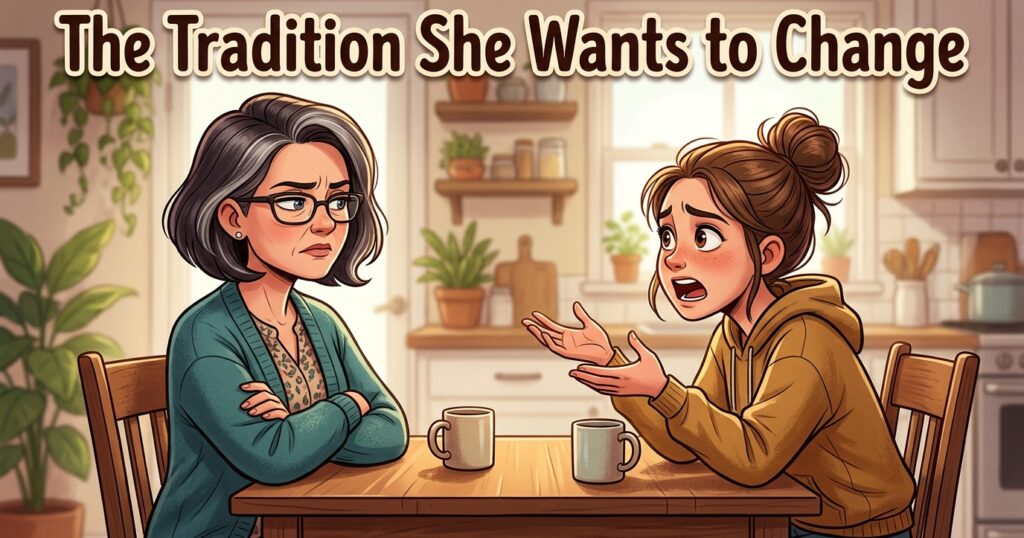
This year, your 13-year-old granddaughter, Maya, joins you in the kitchen. After a few minutes, she looks at the ingredients and says:
“Grandma, could we make half of them differently this year? Maybe chocolate with orange icing? I found a recipe online that looks amazing.”
You feel a little tug in your heart.
These biscuits have always been made exactly the same way.
You worry that if every generation starts changing the tradition, eventually the original may disappear altogether.
At the same time, Maya looks genuinely excited.
Family traditions often look simple from the outside.
A certain meal. A familiar song. Decorations brought out every year. A recipe written on an old card.
But inside a family, these ordinary things can hold extraordinary amounts of meaning.
That faded recipe card may remind Grandma of her own mother. The smell of the biscuits may bring back a kitchen that no longer exists and voices she can still hear in her memory.
So when Maya asks to change the recipe, Grandma may feel something deeper than disappointment.
She may feel afraid of losing a connection to the past.
And yet Maya’s request carries meaning, too.
At thirteen, she is beginning to bring more of herself into family life. She has her own tastes, ideas, and enthusiasm. Her suggestion is not necessarily a rejection of Grandma’s tradition.
It may actually be an invitation.
She is saying, in her own way, “Can I be part of this too?”
The strongest response honors both of those truths.
Option A: Keep the tradition exactly as it is
There is something understandable about wanting to protect a treasured family ritual.
Traditions gain much of their power through repetition. The same recipe, the same smell filling the kitchen, the same story told every year, these details help children feel connected to something larger than themselves.
Grandma may reasonably think, “If I change it now, what will be left of the original in twenty years?”
So saying no may feel less like stubbornness and more like stewardship.
But there is a drawback.
If Maya repeatedly experiences family traditions as something already decided by older generations, she may eventually stop feeling ownership of them.
The tradition remains intact but the relationship around it may become less alive.
Children are more likely to carry family customs forward when they feel that there is room for them inside those customs.
Option B: Replace the traditional recipe
This choice comes from a generous place.
Grandma may want Maya to know that her ideas matter. She may worry that insisting on the old recipe will make her seem rigid or dismissive.
Giving Maya complete control might therefore feel like a wonderfully accepting response.
But Grandma does not need to erase her own feelings in order to respect her granddaughter’s.
Healthy relationships are not built by one person always stepping aside.
They grow when two people learn to make room for what matters to each of them.
Replacing the original recipe entirely could unintentionally send the message that preserving family history and encouraging new ideas cannot happen at the same time.
They can.
Option C: Keep the original recipe but avoid the conversation
This option may feel peaceful in the moment.
Grandma might think, “I don’t want to turn a happy afternoon into a serious discussion. We’ll just make the biscuits and move on.”
Many loving grandmothers avoid difficult conversations precisely because they want family time to feel warm.
But avoiding the subject leaves something important unsaid.
Maya does not learn why the recipe matters so deeply to Grandma.
And Grandma does not learn what excites Maya about creating something new.
Sometimes a small disagreement can become an opportunity for closeness when we are willing to explain ourselves gently.
Grandchildren benefit from discovering that adults have feelings and histories too.
They also benefit from seeing that differences do not have to threaten a loving relationship.
Option D: Share the meaning and make room for something new
This is the best response.
Grandma might say:
“Sweetheart, I love your idea. I want to tell you something first, though. This old recipe means a great deal to me because my mother made these biscuits every Christmas. Making them helps me remember her. How about we make a batch of hers—and then you teach me your chocolate-orange version? We could even write your recipe on a card of its own.”
That response does several beautiful things at once.
First, Grandma is honest.
She does not hide behind “because that’s the way we’ve always done it.”
Instead, she helps Maya understand the story beneath the tradition.
That matters.
Children and teenagers often respond more thoughtfully when they understand the meaning behind a family custom instead of simply being told to preserve it.
Second, Grandma welcomes Maya’s creativity.
She is saying, “Your ideas belong here too.”
That can be especially meaningful during the early teenage years, when young people are beginning to form a stronger sense of identity.
They naturally want more opportunities to make choices, express preferences, and contribute something of their own.
Inviting Maya to add rather than simply obey gives her a genuine role in the family story.
And finally, the new recipe card creates something wonderful:
continuity without rigidity.
Perhaps Grandma’s mother’s card remains safely in the recipe box.
Beside it, there may one day be another card:
Maya’s Chocolate-Orange Christmas Biscuits started when Maya was 13.
Years later, Maya may pull out both cards for her own children.
She might say:
“This one belonged to your great-great-grandmother. And this one your great-grandma and I made together.”
What began as a request to change a tradition has become another tradition.
The Bigger Lesson
Grandmothers often hold an important place in family memory.
We remember the recipes.
We know why a particular ornament matters.
We remember the relatives whose names younger generations may barely know.
There is great value in passing those stories along.
But preserving family traditions does not always mean freezing them in time.
Sometimes the most enduring traditions are the ones spacious enough to welcome another generation.
There is also something powerful about telling grandchildren why a custom matters.
Instead of saying:
“We do it this way because we always have,”
we can say:
“I want to tell you why this means so much to me.”
That little change opens a door.
Now the child is not simply following a rule.
She is receiving a piece of family history.
And when we add another question
“What would you like to bring to it?”
—we open a second door.
We allow the next generation to become caretakers of that history rather than merely observers of it.
Of course, not every tradition needs to change.
There may be recipes, ceremonies, or customs that a family chooses to preserve closely.
But even then, warmth and explanation usually build more connection than insistence alone.
The heart of a tradition is rarely the exact icing, song, tablecloth, or recipe.
The heart is the message beneath it:
You belong to something that began before you, and there is room for you in what comes next.
That may be one of the most meaningful gifts a grandmother can pass down.
Not simply, “Here is our family tradition.”
But:
“Here is our family story. Come help us write the next chapter.”



