
Disclaimer: Devoted Grandma is reader-supported. If you purchase anything through my site, I may receive a small commission (at no cost to you). Thank you.
Your 9-year-old grandson, Noah, has been watching his older brother ride his bicycle to a nearby shop with friends. One Saturday afternoon, while he is staying with you, Noah grabs his helmet and asks eagerly:
“Grandma, can I ride to the shop by myself? It’s not that far. Mom never lets me, but I know I can do it!”
You can see how much this matters to him. He wants to feel grown-up and trusted, especially because his older brother is allowed more freedom.
You also know that his parents don’t yet feel he is ready to make the trip alone.
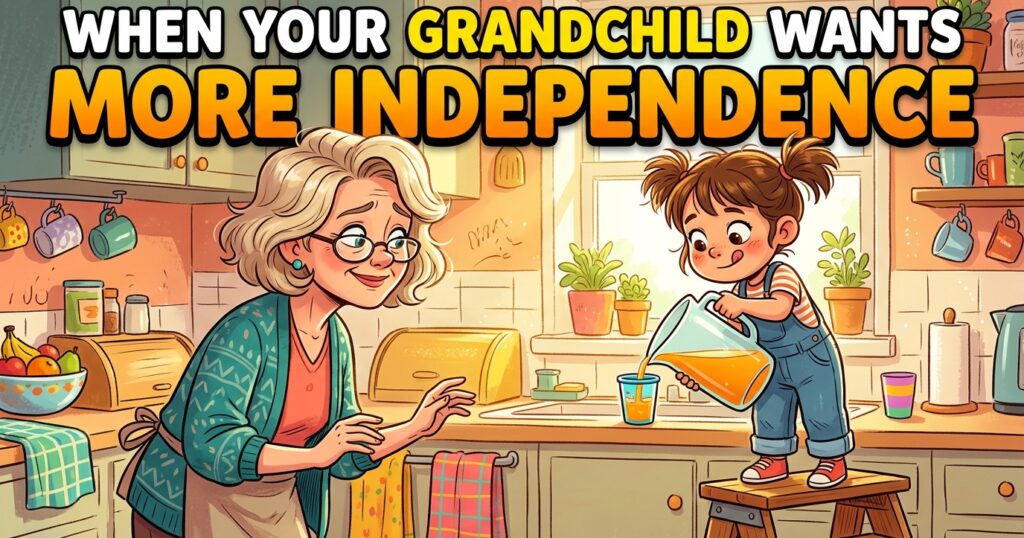
There is something especially tender about the moment a grandchild begins asking for more independence.
One day, they are reaching for your hand to cross the street. Before you know it, they are pulling away and saying, “I can do it myself.”
For a grandmother, that can stir up all sorts of feelings. Pride. Worry. Nostalgia. And perhaps even the temptation to give a grandchild a little more freedom than Mom or Dad would allow.
But moments like this are about much more than a bicycle ride to the shop. They are opportunities to teach a child what growing up really means.
Why A is tempting but risky
A says to let Noah go and keep it between the two of you.
Many grandmothers might understand the temptation.
Perhaps you remember your own childhood, when children seemed to roam the neighborhood more freely. You may look at Noah and think, “He’s sensible. The shop is close. What could happen?”
You may also enjoy being the grandmother who says yes when the parents say no.
But the phrase “Don’t tell your mother” creates a much bigger problem than the bicycle ride itself.
Children need to know that the adults who care for them are on the same team. When one trusted adult asks a child to keep something from another trusted adult, it can blur an important boundary.
It can also damage trust between you and your grandchild’s parents.
Grandparents do not have to agree with every parenting decision. But when a parent has established a reasonable safety boundary, secretly ignoring it puts the child in an uncomfortable position.
No outing is worth asking a grandchild to carry a secret between the adults they love.
Why B sets the boundary but misses the feeling
B says, “Absolutely not. You’re much too young.”
This response certainly makes the rule clear.
And sometimes children do need a firm no.
The difficulty is that Noah is not simply asking for a bicycle ride. Underneath his question is another one:
“Do you think I’m capable?”
Children approaching the next stage of independence often become highly sensitive to comparisons with older siblings and friends. A quick dismissal such as “You’re too young” can sound to a child like, “I don’t trust you.”
That may not be what Grandma means at all.
Instead of shutting down the conversation, this moment can become an opportunity to recognize Noah’s growing confidence while still holding the boundary.
We can say no without making a child feel small.
Why C comes closer but puts Grandma in the middle
C tells Noah that you think he is probably ready, but that he has to convince his parents.
At first glance, this sounds reasonable. After all, you are still respecting the parents’ authority.
But there is a subtle problem.
By telling Noah that you think his parents are being overly cautious, you may accidentally create a little alliance: Grandma and Noah on one side, Mom and Dad on the other.
Now Noah may go home saying, “Grandma thinks I’m ready!”
Instead of helping the family communicate, Grandma has become part of the argument.
There may certainly be times when grandparents and parents see a child’s readiness differently. That is normal. Those conversations, however, are usually better held adult-to-adult rather than through the child.
Why D is the BEST response
D acknowledges Noah’s desire for independence, respects his parents’ boundary, and helps him work toward greater freedom.
This response does three valuable things at once.
First, it recognizes the feeling underneath the request.
You might say, “I can see why you want to ride there yourself. You’re getting older, and it feels good to be trusted with things on your own.”
That simple acknowledgment tells Noah, “I see you growing.”
Second, you maintain the boundary.
You could gently explain, “Your mom and dad have decided you’re not ready to make that trip alone yet, so when you’re with me, I’m going to respect that.”
There is no criticism of his parents. No secret agreement. No shame.
Just a calm boundary.
And third and perhaps most importantly you give Noah a path forward.
Instead of independence being something adults mysteriously grant or refuse, you can help him understand that independence develops through practice.
Perhaps you could ride the route together. Ask Noah to show you where he should stop and look for cars. Let him lead while you follow a short distance behind. Talk about what he would do if his bicycle chain came off, if someone he didn’t know approached him, or if the shop were unexpectedly closed.
Suddenly, “No, you can’t” becomes:
“Not yet—but you’re learning.”
That little word yet can make an enormous difference.
Children need limits, but they also need to see that limits can change as their skills, judgment, and maturity grow.
And grandparents can play a beautiful role in that growth.
We do not have to rush our grandchildren toward independence. Nor do we have to hold them tightly simply because we remember when they were small.
We can stand beside them as they practice becoming capable.
The goal is not to say yes to everything a grandchild wants.
The goal is to help them become the kind of young person who will eventually be ready for that yes.
So the next time your grandchild says, “But I’m old enough!” you might resist the urge to immediately agree or disagree.
Instead, listen for the deeper request:
“Do you see me growing?”
Then let your answer be both loving and steady:
“I do. And I’ll help you get ready for the next step.”
That is how boundaries become something more than restrictions.
They become bridges toward independence and toward the deep trust between a grandparent and grandchild that can last a lifetime.



