
Disclaimer: Devoted Grandma is reader-supported. If you purchase anything through my site, I may receive a small commission (at no cost to you). Thank you.
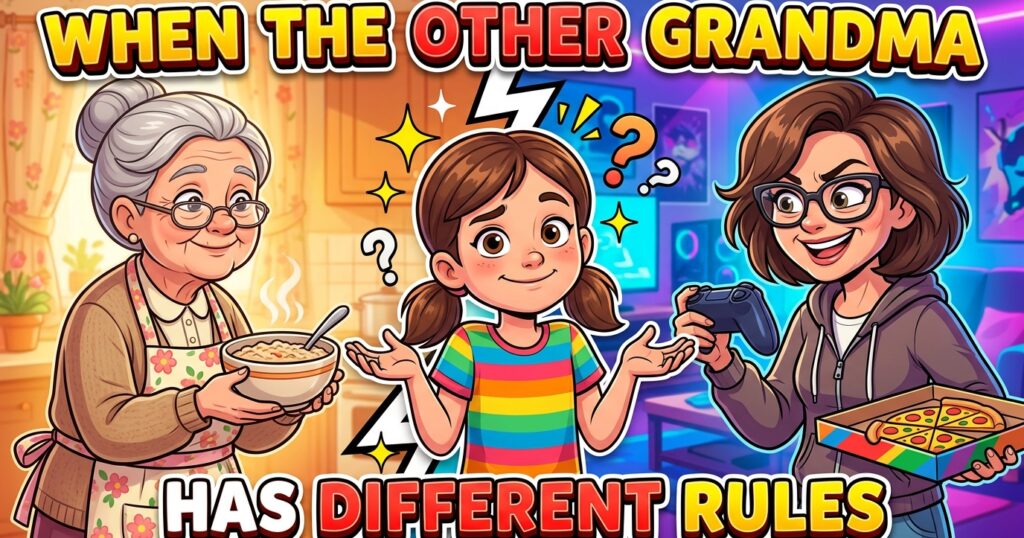
Your 9-year-old grandson, Noah, has just come home from spending the weekend with his other grandmother.
He’s practically bouncing as he tells you all about it.
“Grandma Linda lets me stay up until 11!”
Then comes another.
“And she lets me have dessert before dinner sometimes.”
You smile, but you feel a little tightening in your chest.
Then Noah adds, with complete innocence:
“She’s more fun because she doesn’t have as many rules as you.”
Ouch.
You know he probably doesn’t mean to hurt you, but suddenly you feel yourself being compared to another grandmother—and losing.
Part of you wants to explain why your rules are better. Another part wants to prove that you can be just as much fun.
So what should you do?
A. Relax your rules the next time Noah visits so he sees that you can be the “fun grandma,” too.
B. Tell Noah that every grandmother has different rules, then explain why your rules are healthier and more responsible than Grandma Linda’s.
C. Smile and say, “It sounds like you had a wonderful time with Grandma Linda. Different homes have different rules, and when you’re here, we’ll follow ours. Now tell me what your favorite part of the weekend was.”
D. Tell Noah gently that saying one grandmother is “more fun” can hurt people’s feelings and ask him not to compare the two of you.
There are few things quite as uncomfortable as feeling compared to another grandmother.
We, grandmothers, may be grown women with decades of life experience, but that doesn’t mean our feelings suddenly become immune to jealousy.
When a grandchild says, “My other grandma lets me…” or, worse, “She’s more fun,” it can touch a surprisingly tender place.
You may find yourself wondering, Does he like being with her more? Am I too strict? Should I loosen up?
Those feelings are understandable.
But moments like this give us a beautiful opportunity to remember something important: grandparenting is not a competition.
Your grandchild does not need two identical grandmothers.
He needs two loving relationships.
Let’s look at the four possible responses.
Option A: Relax your rules so you can be the “fun grandma,” too.
It’s easy to see why this might be tempting.
None of us wants our grandchildren to think visiting us feels like entering a house full of restrictions. If another grandmother seems to offer later bedtimes, extra sweets, unlimited television, or fewer chores, you may feel pressure to compete.
But changing your values simply to win popularity can create an uncomfortable pattern.
Children are remarkably quick to notice when adults can be persuaded by comparison.
Today it might be, “Grandma Linda lets me stay up late.”
Next time it could become, “Grandma Linda bought me this,” or, “Grandma Linda never makes me clean up.”
If you begin adjusting your boundaries every time another adult does things differently, your grandchild may unintentionally learn that relationships are negotiations based on who gives him more.
Children actually benefit from learning that different homes have different expectations.
Consistency helps them know what to expect from you.
You can absolutely be playful, flexible, and joyful without abandoning the routines that matter to you.
Option B: Explain why your rules are healthier and more responsible.
This response sounds reasonable on the surface.
After all, perhaps you do have thoughtful reasons for an earlier bedtime or limits on sweets.
But there is a subtle danger here.
The conversation can quickly turn into an unspoken contest between grandmothers.
Even if you never say, “Grandma Linda is wrong,” your grandchild may hear something like, “My way is better than hers.”
That places him in an uncomfortable emotional position.
Children should not feel that enjoying one grandparent means betraying another.
They are capable of loving different people who have different personalities, homes, traditions, and rules.
Unless another caregiver is doing something genuinely unsafe, you usually don’t need to evaluate her choices in front of your grandchild.
You can simply stand comfortably in your own.
Option C: Acknowledge his happiness, calmly state your boundary, and stay curious.
This is the best response.
“It sounds like you had a wonderful time with Grandma Linda. Different homes have different rules, and when you’re here, we’ll follow ours. Now tell me what your favorite part of the weekend was.”
There is a lot of wisdom packed into those few sentences.
First, you are refusing to compete.
Rather than reacting to “Grandma Linda lets me…” with defensiveness, you allow your grandson to enjoy his relationship with her.
That communicates emotional security.
You are essentially saying, You are allowed to love her. Your happiness with her does not threaten my relationship with you.
What a gift that is for a child.
Second, you calmly maintain your own boundaries.
“Different homes have different rules” is a wonderfully useful phrase because it neither apologizes nor criticizes.
It simply describes reality.
Children encounter this everywhere.
School has one set of rules. Home has another. A friend’s house may have another.
Learning to adapt to different environments is part of growing up.
And finally, you turn the conversation back toward connection.
“Tell me your favorite part.”
That question reminds both of you that the real issue is not who allows the latest bedtime.
The real issue is relationship.
When grandchildren feel that they can freely tell you about their lives, including wonderful experiences they have with other people—you become a safe emotional home for them.
Option D: Tell him the comparison hurts your feelings.
There is nothing wrong with teaching children that words affect people.
But in this particular moment, asking Noah not to compare the two grandmothers may unintentionally make him feel responsible for managing your emotions.
At nine years old, he is probably not making a sophisticated judgment about your worth as a grandmother.
He is simply noticing something children notice very quickly:
Different adults have different rules.
When he says the other grandmother is “more fun,” he may really mean, “I liked staying up late.”
Those are not necessarily the same thing.
There may certainly be a time to teach kindness in how we speak about people, but the first priority here is not correcting his loyalty or protecting your pride.
It is showing him that your relationship is strong enough to survive comparison.
That kind of confidence is powerful.
The Bigger Lesson
Grandchildren will compare us.
They compare parents, teachers, coaches, friends—and yes, grandmothers.
One grandmother may bake cookies every visit.
Another may take them fishing.
One may have very few household rules.
Another may believe bedtime is bedtime, even at Grandma’s house.
You do not need to win.
Your grandchild will remember far more than what time you let him stay up.
He will remember how he felt around you.
Could he talk openly?
Could he enjoy other people without worrying that you would become jealous?
Did your boundaries feel steady rather than punitive?
Did he know that your love was not something he had to earn by declaring you his favorite?
The most secure grandparents quietly communicate:
There is room in your heart for many people.
And there is something wonderfully freeing about that.
You can admire the relationship your grandchild has with another grandmother without diminishing your own.
Her way does not need to be your way.
Your traditions, your values, your humor, your stories, and your particular way of loving your grandchild all become part of the rich collection of relationships that help shape his childhood.
So the next time you hear, “My other grandma lets me…”
Smile if you can.
Listen.
Stay steady.
And remember:
You do not have to be the grandmother who allows the most.
You simply want to be the grandmother whose love feels safe, dependable, and wonderfully her own.



