
Disclaimer: Devoted Grandma is reader-supported. If you purchase anything through my site, I may receive a small commission (at no cost to you). Thank you.
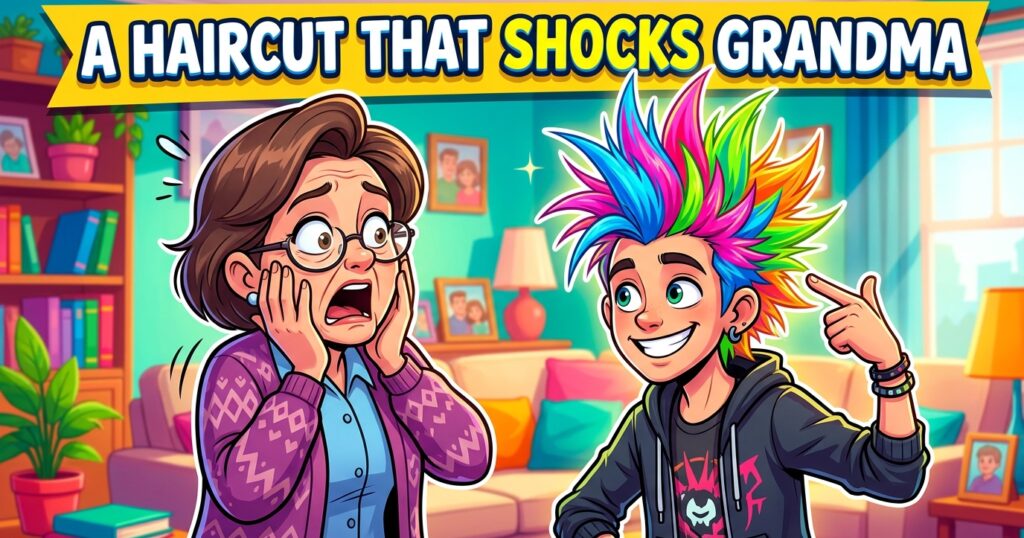
Your grandchild comes through the door practically glowing.
“Grandma! Look!”
You turn around—and nearly lose your words.
Their once-familiar hair has been transformed into something dramatic: perhaps one side is shaved, the rest dyed electric blue, or there are sharp layers sticking out in every direction. Whatever the style, it is definitely not something you would have chosen.
Your grandchild beams, runs a hand through the new look, and asks eagerly:
“Do you love it?”
You love your grandchild dearly.
The haircut?
Not so much.
For a split second, you’re caught between two instincts: being honest and protecting their feelings.
There are moments in grandparenting when love asks us to hold our tongues—not because honesty is unimportant, but because the deeper question may not be the one being spoken aloud.
When a grandchild asks, “Do you love my haircut?” they may sound as though they are asking for a fashion review.
But often they are asking something much more tender:
Do you still see me positively when I look different?
Can I show you who I’m becoming without disappointing you?
Is Grandma still a safe person for me when my tastes aren’t hers?
That is why this seemingly small moment can carry surprising emotional weight.
Option A: “I really don’t like it.”
There is something admirable about wanting to be truthful.
Many grandmothers were raised to believe that honesty means saying plainly what you think. And if your grandchild has always had beautiful curls, lovely long hair, or a tidy style you adored, seeing it suddenly changed can genuinely be a shock.
You may even worry they will regret it.
But saying, “I liked your hair better before,” at the very moment they are proudly revealing the change can land much harder than intended.
Children and teenagers are still forming their identities. Clothing, music, hairstyles, hobbies, and appearance often become ways of experimenting with the question, Who am I?
A grandmother’s disapproval can therefore feel less like a comment about hair and more like a comment about the person wearing it.
Your grandchild may hear:
Grandma liked the old me better.
That probably isn’t what you mean at all.
The problem with Option A is not honesty itself. It is the timing and focus of that honesty.
Not every truthful thought needs to be spoken immediately.
Option B: “I absolutely love it!”
This response comes from a loving place too.
You see that shining face and think, I’m not going to ruin this moment.
So you gush.
The difficulty is that children, especially older grandchildren, can be remarkably good at detecting insincerity.
If your eyes widen in surprise while your mouth declares, “I LOVE it!”, they may know immediately that Grandma is putting on an act.
And that creates another problem.
One of the great gifts a grandparent can offer is trustworthy warmth: the feeling that Grandma will be kind without being false.
You don’t have to pretend your personal taste has suddenly changed just to make your grandchild feel accepted.
Acceptance and agreement are not the same thing.
You can love the person completely without loving every hairstyle, outfit, song, tattoo, hobby, or trend they choose.
Option C: “You look so happy with it. Tell me what you love about it.”
This is the best response.
Notice what it does beautifully.
You are not lying.
You are not criticizing.
And you are not making the moment about your personal preferences.
Instead, you become curious.
Perhaps your grandchild says, “I’ve wanted to do this forever!”
Or, “My friend helped me choose the color.”
Or, “I finally feel like this looks like me.”
Suddenly, instead of discussing whether Grandma approves of blue hair or shaved sides, you are learning something about your grandchild.
That is a wonderful trade.
Curiosity communicates something powerful:
Your inner world matters to me.
For younger grandchildren, supportive curiosity helps strengthen confidence and emotional security. For teenagers and young adults, it also respects their growing independence.
And there is another advantage.
When grandchildren learn that Grandma will listen before judging, they are more likely to come back with the bigger things.
Today it may be a haircut.
Years from now it may be a friendship problem, heartbreak, career decision, or difficult mistake.
Trust is built in hundreds of little moments before it is needed in the big ones.
Option D: “Well, hair grows back!”
Many grandmothers might reach for humor or a quick subject change because they are afraid their face will reveal too much.
And yes, changing the subject may prevent immediate criticism.
But “hair grows back” can accidentally sound like:
Don’t worry, you can fix this mistake later.
That is not quite the enthusiastic reception your grandchild was hoping for.
Likewise, rapidly asking whether they are hungry sends the message that Grandma would rather escape the conversation than engage with it.
You don’t need to manufacture enthusiasm for the haircut itself.
But you can show genuine enthusiasm for them.
The Heart of the Matter
One of the most freeing lessons in grandparenting is realizing that our grandchildren do not need to become smaller versions of us in order to remain close to us.
They may choose clothes we would never wear.
They may listen to music that sounds like noise to our ears.
They may decorate their rooms strangely, follow trends we don’t understand, or choose hairstyles that make us privately wonder, What on earth happened at that salon?
And still, there is an opportunity hidden inside those differences.
Instead of asking ourselves,
“Do I approve?”
we might sometimes ask,
“What can I learn about my grandchild here?”
You can always say something genuine:
“You certainly surprised me!”
“That’s quite a transformation.”
“You look very pleased with it.”
“I can tell you were excited to try something different.”
“Tell me about how you chose it.”
None of those sentences requires you to pretend the hairstyle is your cup of tea.
They simply keep the door open.
And perhaps that is one of a grandmother’s most beautiful jobs: keeping that door open as grandchildren grow, change, experiment, stumble, discover themselves, and occasionally walk through the door with hair that nearly makes Grandma drop her teacup.
The hairstyle may be temporary.
The feeling of being accepted by Grandma can last a lifetime.



