
Disclaimer: Devoted Grandma is reader-supported. If you purchase anything through my site, I may receive a small commission (at no cost to you). Thank you.
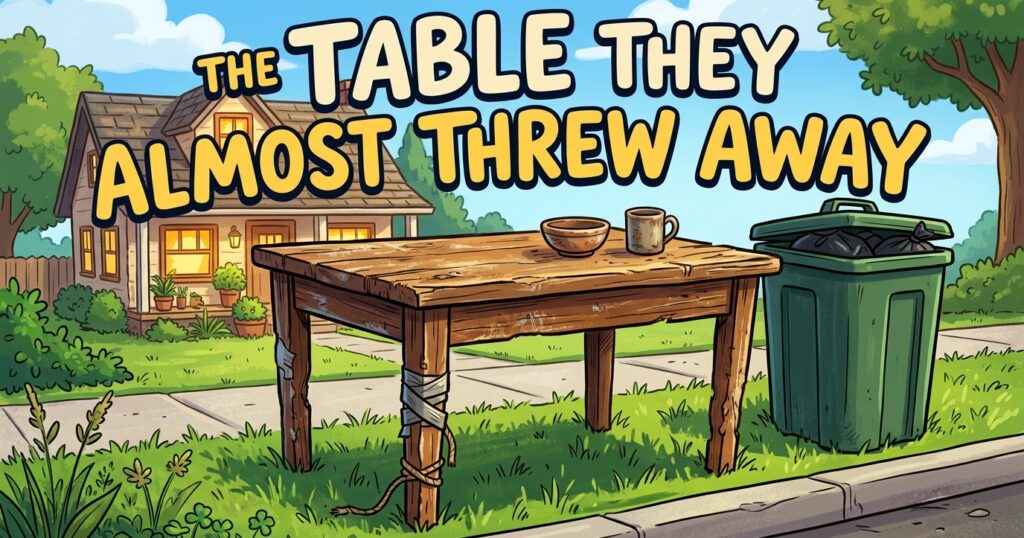
When Emma was eight years old, her grandfather built a wooden table for the family kitchen.
It wasn’t fancy.
The legs were slightly uneven.
One corner had a little dent.
And Grandpa had accidentally left a pencil mark underneath the tabletop.
But the family loved it.
They ate breakfast there.
Did homework there.
Wrapped Christmas presents there.
Arguments happened there too.
So did apologies.
Over the years, the table collected scratches, stains, dents, and mysterious little marks nobody remembered making.
Then, when Emma was twenty-eight, her parents moved to a smaller house.
“Do you want Grandpa’s table?” Mom asked.
Emma looked at it.
The surface was scratched.
One leg wobbled.
There was a dark stain near the middle.
“Maybe we should just get rid of it.”
Her father looked horrified.
“Get rid of it?”
“It’s old.”
“So am I.”
“We’re not throwing you away, Dad.”
“Good to know.”
Emma laughed.
Eventually, she agreed to take the table.
Her husband, Nathan, helped her load it into their garage.
“We could buy a new one,” he said.
“I know.”
“So why are we keeping this?”
Emma ran her hand across the scratched wood.
“Because Grandpa made it.”
Nathan smiled.
“Then I guess we’re fixing it.”
They thought the job would take an afternoon.
It didn’t.
First, they tightened the legs.
Then they sanded the surface.
Some scratches disappeared quickly.
Others were surprisingly deep.
“This one isn’t coming out,” Emma said.
Nathan looked at it.
“Then we’ll work around it.”
They filled cracks.
Smoothed rough areas.
Repaired one corner.
Then they applied a fresh finish.
For several days, the table sat in the garage while they worked on it little by little.
One evening, Emma stared at it.
“It’s funny.”
“What?”
“If I’d known this would take so much work, I might have bought a new one.”
Nathan laughed.
“That’s probably true about a lot of things.”
Neither of them knew how important that sentence would become.
A few years later, Emma and Nathan went through a difficult season.
Nothing enormous happened.
There was no dramatic betrayal.
No single terrible argument.
Instead, their relationship became worn down by hundreds of little things.
Work was busy.
Money was tight.
Their children needed constant attention.
They were both tired.
Conversations became practical.
“Did you pay the bill?”
“Who’s picking up the kids?”
“Did you buy milk?”
“Don’t forget the appointment.”
They stopped sitting together after dinner.
Stopped asking how the other person was really doing.
Small annoyances became larger.
Nathan felt Emma criticized everything he did.
Emma felt Nathan never listened.
Both believed they were putting in more effort than the other.
One evening, they argued over something completely ridiculous.
A dishwasher.
Nathan loaded it differently from the way Emma preferred.
She complained.
He snapped.
Within five minutes, they were no longer arguing about plates.
They were arguing about everything.
“You don’t appreciate anything I do!”
“Because I have to ask you ten times!”
“That’s not true!”
“It feels true!”
Then Nathan walked into the garage.
Emma followed a few minutes later.
Neither spoke.
The old kitchen table was stored there temporarily while they repainted the dining room.
Nathan sat beside it.
His hand rested on one of the old scratches.
“Remember fixing this?”
Emma nodded.
Nathan pointed at the mark.
“We couldn’t get this one out.”
“I remember.”
“So we kept the table anyway.”
Emma knew exactly what he meant.
“I’m not a table, Nathan.”
“I know.”
“Good.”
He laughed.
She did too.
It was the first time they’d laughed together all week.
Then Nathan became serious.
“I think we’ve been expecting this marriage to stay good without actually doing much to keep it good.”
Emma sat beside him.
That hurt because it was true.
Somewhere along the way, they’d started treating their relationship like something that should simply work.
If they loved each other, shouldn’t everything come naturally?
But love hadn’t eliminated exhaustion.
It hadn’t eliminated misunderstandings.
It hadn’t magically taught them how to communicate.
And it certainly hadn’t made two imperfect people stop being imperfect.
So they started repairing.
Not with one enormous romantic gesture.
With small things.
Nathan started putting his phone away when Emma was talking.
Emma worked on bringing up problems without turning them into accusations.
They made time to go for walks together.
They asked questions again.
They apologized sooner.
They learned to say, “That’s not what I meant. Let me try again.”
Some conversations were uncomfortable.
Some old hurts took longer to work through.
There were days when one person had more patience than the other.
And occasionally, they still argued about the dishwasher.
But they kept returning to each other.
Years passed.
One evening, their teenage daughter was sitting at the old table complaining about her best friend.
“She’s driving me crazy.”
“What happened?” Emma asked.
Her daughter explained.
There had been a misunderstanding.
Neither girl wanted to apologize first.
“I’m just done with her.”
Emma listened.
Then she pointed at the table.
“See that scratch?”
Her daughter rolled her eyes.
“Mom, please don’t turn the furniture into a life lesson.”
Nathan nearly choked on his coffee.
Emma laughed.
“Unfortunately, that’s exactly what’s about to happen.”
She told her daughter how Grandpa had built the table.
How it had become damaged.
How they’d almost thrown it away.
And how much work it had taken to restore.
“Good relationships are a little like this,” Emma said.
“They get scratched?”
“Sometimes.”
“They wobble?”
“Definitely.”
Nathan added, “Sometimes someone loads the dishwasher incorrectly.”
Emma gave him a look.
Their daughter laughed.
Then Emma continued.
“People disappoint each other. We misunderstand each other. We get busy. We say things badly. We change. Sometimes relationships go through seasons when being close doesn’t feel easy.”
“So you just put up with everything?”
“No.”
Emma shook her head.
“Some relationships aren’t healthy or safe, and walking away can be necessary. But when you have a good relationship with someone who cares about you, don’t assume every difficult season means the relationship is ruined.”
She touched the old wood.
“Sometimes it needs attention.”
That evening, her daughter called her friend.
The conversation wasn’t perfect.
But it was a beginning.
And perhaps that is what we sometimes forget about relationships.
We admire the friendships that last forty years.
The marriages that survive decades.
The siblings who remain close.
The grandparents and grandchildren who genuinely know one another.
But we often see the finished table.
We don’t see all the repairs.
The phone calls someone made even when they were busy.
The apologies.
The forgiveness.
The difficult conversations.
The decision to listen instead of winning.
The patience during stressful seasons.
The effort to stay connected when distance made it inconvenient.
The choice, over and over, to say:
You matter enough for me to keep showing up.
Because good relationships are not good because nothing ever goes wrong.
They’re good because when ordinary wear and tear appears, both people care enough to tend to it.
Some scratches may remain.
Some disagreements may never disappear completely.
That’s okay.
A relationship doesn’t need to be flawless to be strong.
It needs care.
It needs patience.
It needs honesty.
It needs forgiveness.
And most of all, it needs people who understand that love isn’t only something you feel.
Sometimes love is the quiet, repeated effort of taking care of something you don’t want to lose. 💛
