
Disclaimer: Devoted Grandma is reader-supported. If you purchase anything through my site, I may receive a small commission (at no cost to you). Thank you.
When Daniel received his first proper paycheck, he felt rich.
Not buy-a-private-island rich.
But definitely order-dessert-without-looking-at-the-price rich.
After years of studying and struggling, money was finally coming in regularly.
Daniel had plans for every dollar.
New clothes.
A better phone.
Weekend trips.
A nicer car.
His uncle Samuel had another suggestion.
“Start investing.”
Daniel groaned.
“Uncle, I’ve only just started earning.”
“Exactly.”
“I’ll invest when I make more money.”
Samuel smiled.
“Most people say that.”
“I can’t invest much now anyway.”
“Who said it has to be much?”
Daniel shrugged.
To him, investing was something wealthy people did with enormous amounts of money.
Then one Saturday, Samuel invited Daniel to his small farm outside town.
Behind the house was an orchard filled with fruit trees.
Some were enormous.
Others were young saplings.
Samuel handed Daniel a basket.
“Help me pick.”
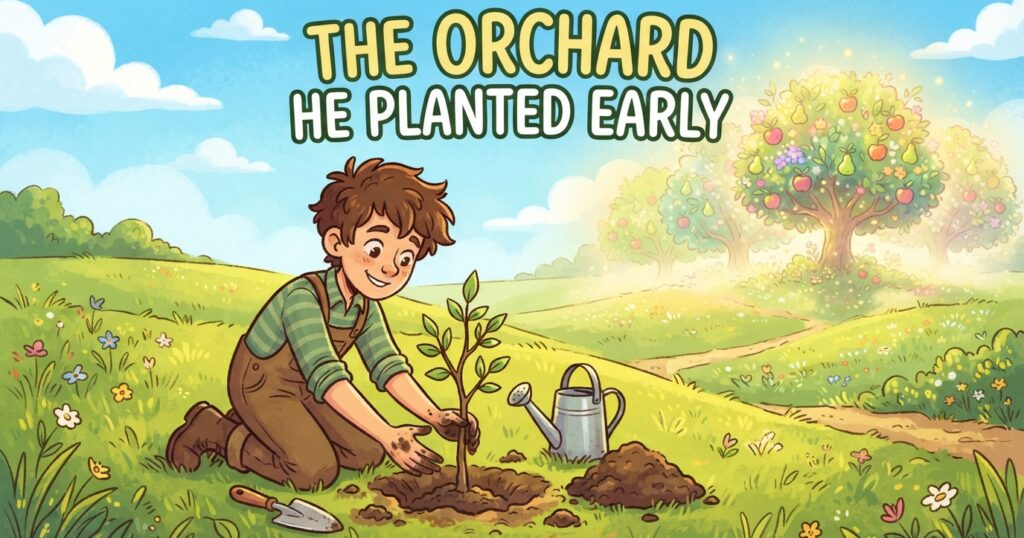
As they worked, Daniel noticed a tiny tree supported by two wooden stakes.
“That one’s not doing much,” he said.
“It’s three months old.”
“How long before you get fruit?”
“A few years.”
Daniel laughed.
“You planted something now for fruit you won’t get for years?”
Samuel stared at him.
“That’s generally how trees work, Daniel.”
“You know what I mean.”
Samuel smiled.
“That’s also how many worthwhile investments work.”
Daniel rolled his eyes.
“Here comes the lesson.”
“You walked into my orchard. That’s your own fault.”
They both laughed.
Then Samuel became serious.
“When I was your age, I thought investing meant finding something that would make me rich quickly.”
“Did you?”
“I found several things that made other people rich quickly.”
Daniel laughed.
Samuel continued.
“I put money into things because friends were excited about them. I chased promises. I invested without understanding what I was buying.”
“What happened?”
“I lost money.”
Samuel picked another piece of fruit.
“Eventually, I learned to stop asking, ‘How fast can this make me money?’ and start asking better questions.”
“Like what?”
Samuel counted on his fingers.
“What am I investing for?”
“How long can I leave the money alone?”
“How much risk can I actually handle?”
“Do I understand what I’m putting my money into?”
“And am I spreading my money wisely instead of betting everything on one idea?”
Daniel looked around the orchard.
Samuel pointed toward the trees.
“I don’t have only mangoes here.”
Daniel looked around.
There were oranges, lemons, avocados, and several other fruit trees.
“If something affects one crop,” Samuel explained, “I don’t necessarily lose everything.”
Daniel nodded.
“Diversification.”
Samuel looked impressed.
“So you have been listening.”
“A little.”
That evening, Daniel went home thinking about the orchard.
For the first time, he wrote down what he actually wanted money to do for him.
He wanted an emergency cushion.
He wanted to eventually own a home.
He wanted money for retirement.
Perhaps one day he would help his children with education.
Suddenly, “investing” wasn’t simply about becoming rich.
It was about preparing for future versions of his life.
Daniel began learning.
He discovered that different goals needed different plans.
Money he might need soon shouldn’t necessarily be treated the same as money he could leave invested for decades.
He learned that potential returns usually came with risk.
He learned that excitement was not the same thing as a good investment.
Most importantly, he stopped treating investing like gambling on whatever everyone was talking about that week.
He started small.
Every payday, a portion of his income was set aside before he could spend it.
At first, the amount seemed almost pointless.
Daniel would check his progress and think,
“This is going to take forever.”
One afternoon, he complained to Samuel.
“My investments barely seem to be growing.”
Samuel pointed toward the youngest tree in the orchard.
“Pull it out.”
“What?”
“If you’re disappointed it isn’t a forest yet, pull it out.”
Daniel laughed.
“That would be stupid.”
“Exactly.”
Samuel smiled.
“Stop digging up your financial trees every week to see whether the roots are growing.”
So Daniel became patient.
Years passed.
His income increased.
Whenever he earned more, he increased what he put aside.
There were difficult periods.
Markets fell.
Unexpected expenses appeared.
Some investments performed better than others.
Once, Daniel nearly put a large amount of money into something a coworker promised was “guaranteed” to explode in value.
Then he remembered Uncle Samuel.
Do I understand it?
He didn’t.
So he walked away.
The investment later collapsed.
That experience taught Daniel another lesson.
Sometimes good investing wasn’t about knowing what to buy.
Sometimes it was having the discipline to say no.
Many years later, Daniel returned to Samuel’s farm with his young daughter.
The tiny tree they’d once discussed was now tall and full of fruit.
Daniel stopped beneath it.
“Is this the same one?”
Samuel smiled.
“The useless little tree?”
Daniel laughed.
“I didn’t call it useless.”
“You practically did.”
Daniel looked up at the branches.
He could hardly believe it.
Something that had once seemed insignificant had quietly grown while life continued around it.
Paychecks.
Birthdays.
Holidays.
Ordinary Tuesdays.
Years.
Daniel realized his financial life had grown in much the same way.
Not through one brilliant decision.
Not through getting rich overnight.
But through planning.
Consistency.
Patience.
Learning.
And time.
Samuel handed Daniel a piece of fruit.
“Funny thing about planting early.”
“What?”
“For years, it looks like very little is happening.”
He looked toward the orchard.
“Then one day you’re standing in the shade.”
Daniel smiled.
Because that was the part people sometimes missed about investing.
The goal isn’t simply to make money.
It’s to give future you more choices.
More security.
More breathing room.
And that usually requires thinking beyond what feels exciting today.
Know what you’re investing for.
Understand what you own.
Think about risk.
Avoid putting everything in one place.
Be suspicious of promises of easy riches.
Invest consistently when you can.
And give sensible decisions time to work.
You don’t need to have enormous wealth before you start thinking about your future.
Sometimes you simply need to plant the first tree.
Because the best time to appreciate the shade is years from now, but the time to start planning for it is today. 💛
