
Disclaimer: Devoted Grandma is reader-supported. If you purchase anything through my site, I may receive a small commission (at no cost to you). Thank you.
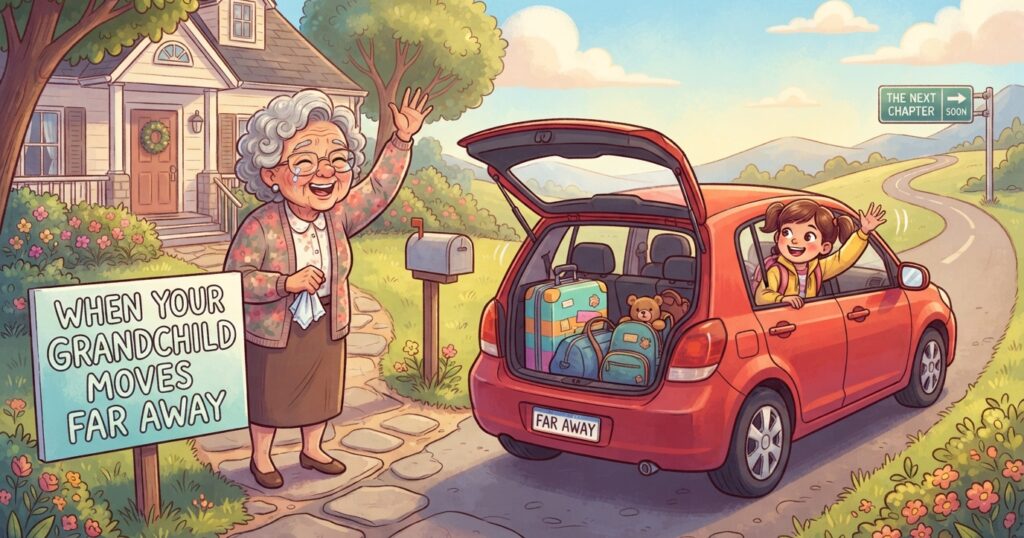
Your 10-year-old grandson, Eli, has lived just twenty minutes away from you his whole life. You’ve been there for birthday breakfasts, school concerts, Saturday afternoons, and those little ordinary visits that somehow became some of your most treasured memories.
Then your daughter calls with big news: her husband has accepted a wonderful new job, and the family will be moving nearly 1,500 miles away.
You know this is a good opportunity for them. You really do. But after you hang up the phone, your heart sinks. You begin imagining missed birthdays, fewer hugs, and your grandson growing taller and changing while you watch from a screen instead of across the kitchen table.
A few days later, Eli comes over and excitedly tells you about his new bedroom, the swimming pool near their new house, and the school he might attend.
You want him to know how much you’ll miss him—but you also don’t want your sadness to become something he has to carry.
When Love Has to Stretch Across the Miles
When a beloved grandchild moves far away, the loss can feel surprisingly deep.
It isn’t only the big occasions we grieve. Often, it is the ordinary things: picking them up from school, hearing their knock at the door, sharing a cookie at the kitchen table, or realizing they might stop by simply because they were nearby.
A grandmother can be genuinely happy for her grandchild and heartbroken for herself at the very same time.
That is why this dilemma requires such a tender balance. A grandchild should be allowed to know that he matters deeply to us. At the same time, he should not feel responsible for protecting us from the changes in his life.
Let’s look at each response.
A. “I don’t know what I’m going to do without you.”
This response comes from a very understandable place.
When we love someone dearly, sometimes our first instinct is to tell them the full weight of what we are feeling. We may hope that saying how devastated we are will communicate just how important they are to us.
And of course, Eli should know that Grandma will miss him.
But there is an important difference between saying, “I’m going to miss you so much,” and saying, “I don’t know what I’m going to do without you.”
The first expresses love.
The second can accidentally create responsibility.
A 10-year-old might hear those words and begin wondering, “Is Grandma going to be okay because I’m leaving?”
Children often absorb emotional messages more deeply than adults realize. Even when they are excited about a move, they may already be feeling nervous about leaving friends, starting a new school, or adjusting to a different home.
Adding Grandma’s emotional well-being to their list of worries can make the transition harder.
Our grandchildren should know that their absence matters to us but they should not feel that our happiness depends upon their physical presence.
B. Tell him you’ll miss him while also showing interest in his new life and making plans to stay connected.
This is the best response.
It allows two important truths to exist together:
“I love you enough to miss you.”
And:
“I love you enough to let you be excited about what comes next.”
You might say something like, “Oh, sweetheart, I am going to miss having you close by so much. But I’m also excited to hear about your new room and your new school. We’ll have to come up with some special Grandma-and-Eli traditions even when we live far apart.”
That kind of message gives a child emotional security.
You are not pretending the move does not hurt. Children usually sense more than we think they do, and pretending everything is perfectly fine can sometimes make feelings seem uncomfortable or forbidden.
Instead, you are modeling something valuable: grown-ups can feel sadness without being overwhelmed by it.
You are also sending another powerful message:
“Distance will change our relationship, but it does not have to weaken it.”
A grandparent-grandchild relationship can remain wonderfully close across hundreds or even thousands of miles when connection becomes intentional.
Perhaps you have a Sunday video call. Maybe you both read the same book and talk about it. You could send postcards, exchange silly photographs, watch the same movie while talking on the phone, or have an ongoing “Grandma and Eli” journal that travels back and forth in the mail.
The particular ritual matters less than the consistency.
Children feel loved when people reliably show up in their lives.
C. Avoid talking about the move.
This option may seem protective.
A grandmother might think, “If I don’t bring it up, perhaps I won’t upset him.”
But silence can communicate unintended messages.
Eli may wonder why Grandma does not seem interested in something so important happening in his life. He might even interpret her silence as disapproval.
Children need safe adults with whom they can talk about complicated experiences.
A move can bring excitement one moment and sadness the next. Eli might proudly describe his new bedroom today and cry about leaving his best friend tomorrow.
If Grandma has shown that the subject is safe to discuss, he will be more likely to share both feelings.
That emotional openness is one of the most precious gifts a grandparent can offer.
D. Focus only on the excitement and hide your sadness.
There is generosity in this choice.
Many grandmothers instinctively want to protect their grandchildren from adult worries. We may think, “I’ll put on a brave face so he doesn’t feel bad.”
That instinct is loving.
But completely hiding your sadness can also miss an opportunity for genuine connection.
Healthy emotional relationships do not require us to pretend.
It is perfectly appropriate to say, “I’m going to miss you terribly,” as long as the message does not become, “You are responsible for making my sadness go away.”
Children learn emotional resilience partly by watching the adults they love experience difficult feelings without being consumed by them.
Grandma can be sad.
Grandma can cry.
Grandma can miss him.
And Grandma can still be okay.
That is a powerful lesson.
Love Can Learn New Ways to Travel
When grandchildren move away, we sometimes fear that distance will quietly erase the closeness we have built.
But relationships are not measured only in miles.
They are strengthened through attention, curiosity, reliability, and affection.
Ask about the names of his new friends. Remember the date of the school play. Let him give you a video tour of his room. Mail him a ridiculous joke. Celebrate the tiny details of his new life rather than only mourning the old one.
And when you miss him, you do not need to hide that love.
You can simply hold your sadness gently.
“I miss you because I love you.”
Those words place no burden on a child.
They simply remind him of something every grandchild deserves to know:
No matter how far away life takes you, Grandma still wants to know your stories, cheer for your adventures, and remain a steady, loving part of your world.



