
Disclaimer: Devoted Grandma is reader-supported. If you purchase anything through my site, I may receive a small commission (at no cost to you). Thank you.
Your 11-year-old grandson, Ethan, has been quieter than usual since his parents separated three months ago.
He used to race into your house talking about school, soccer, and whatever funny thing happened that day. Lately, he drops his backpack by the door, gives you a quick hug, and disappears into the den with his tablet.
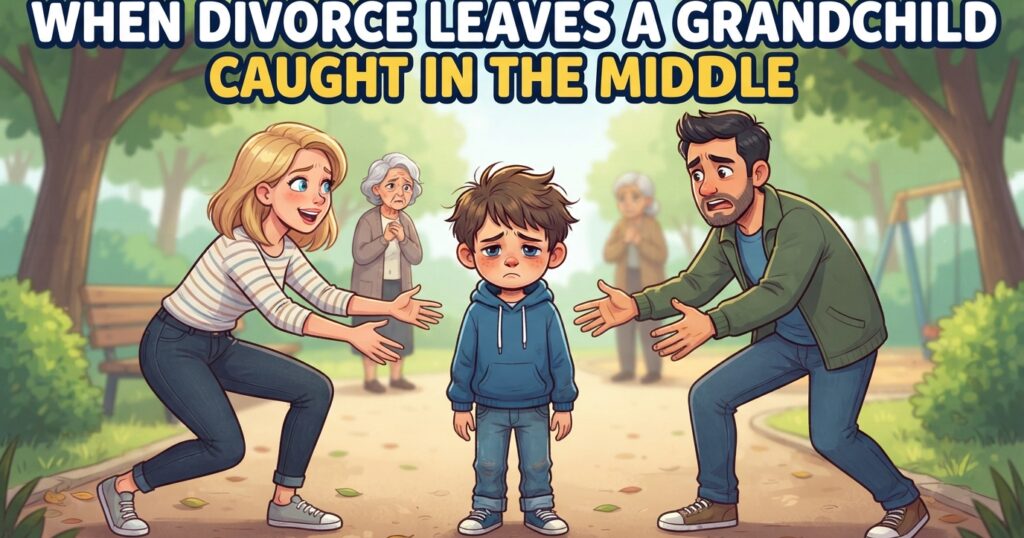
One Saturday afternoon, while the two of you are baking cookies, Ethan suddenly says, “Mom says Dad only cares about himself. Dad says Mom is making everything difficult.”
Then he looks down at the bowl and whispers, “I don’t know who I’m supposed to believe.”
Your heart aches. You love your daughter, and you have strong feelings about how the divorce has unfolded. Part of you wants to explain what you believe really happened.
But Ethan is looking at you, waiting.
Divorce can make a child feel as though the ground beneath his feet has shifted.
The adults may be discussing schedules, money, housing, lawyers, and disagreements. But a child often experiences something much simpler and more frightening:
Is my family still my family?
Do Mom and Dad still love me?
Am I allowed to love both of them?
And sometimes, the hardest question of all:
Whose side am I supposed to be on?
That is what Ethan is really asking his grandmother.
He may appear to be asking, “Who should I believe?” But beneath those words is a deeper emotional need. He wants permission to remain a child rather than become a judge in his parents’ conflict.
That is why Option C is the strongest response.
Telling Ethan, “You don’t have to choose sides,” immediately removes a burden that never belonged on his shoulders in the first place. Asking how the situation feels to him shifts the conversation away from adult accusations and back toward the child’s emotional world.
And listening without criticizing either parent gives him something enormously valuable: a safe place to love both of them.
Why Option A Is So Tempting
Option A — telling Ethan the truth as you see it may come from a loving place.
Grandmothers often know far more about a family situation than grandchildren realize. You may have watched your own child struggle through the marriage. You may feel angry about how a son-in-law or daughter-in-law behaved. You may believe one parent clearly caused more harm than the other.
So when a grandchild says, “I don’t know who to believe,” the instinct to straighten out the story can be powerful.
But even when your version is accurate, sharing adult details can place a child in an emotional loyalty conflict.
Children usually do not experience criticism of a parent as simply information about that parent.
A child may hear:
“If Grandma thinks Dad is a bad person, what does that mean about me, since Dad is part of me?”
Or:
“If I have fun with Mom, am I betraying Dad?”
Your grandson does not need you to decide the case. He needs you to protect his relationship with the people he depends on emotionally.
There may be situations involving safety or serious wrongdoing where trusted adults must intervene. But ordinary marital grievances belong with the adults, not on a grandchild’s shoulders.
Why Option B Helps — But Doesn’t Go Far Enough
Option B — reassuring Ethan that both parents love him and then changing the subject, contains something very important.
A child going through a divorce often desperately needs reassurance that parental love has not disappeared along with the marriage.
Saying, “Your mom and dad both love you very much,” can help restore a sense of security.
The problem comes with changing the subject too quickly.
Ethan has taken a risk by opening up.
Children do not always announce emotional pain directly. They may test the waters with one sentence.
“I don’t know who to believe.”
“I hate going back and forth.”
“Mom cries a lot.”
“Dad has a new girlfriend.”
If Grandma responds with reassurance and immediately moves on, the child may conclude, “She doesn’t want to talk about this.”
Sometimes we change the subject because we are uncomfortable, even though the child is finally ready to talk.
Instead of closing the door, leave it open.
You might say, “You never have to choose between them when you’re with me. What has all of this been like for you?”
Then wait.
Silence can be an invitation.
Why Option C Builds Trust
Option C gives Ethan exactly what children in divided families need: emotional permission.
Permission to love both parents.
Permission to feel angry.
Permission to feel sad.
Permission to miss the old family.
Permission to enjoy time with one parent without feeling guilty about the other.
A wise grandmother does not need to solve every feeling.
Sometimes the most healing response is simply:
“That sounds really hard.”
Or:
“I can understand why you feel pulled in two directions.”
Or:
“You don’t have to figure out the grown-up problems.”
Notice what these responses do not contain.
They do not blame.
They do not interrogate.
They do not correct the child’s version of events.
They communicate. Your feelings are safe with me.
That message can strengthen a grandparent-grandchild relationship for years.
Why Option D May Feel Responsible
Option D, encouraging Ethan to talk directly to his parents, is not entirely wrong.
Healthy communication between children and parents is important. Ethan may eventually benefit from telling his mother or father, “I feel uncomfortable when you say bad things about each other.”
But sending him away from the conversation too quickly can feel like rejection.
He came to Grandma for a reason.
Perhaps you feel safer.
Perhaps you are calmer.
Perhaps you are one of the few adults in his life who is not currently overwhelmed by the divorce.
You can listen first and then gently help him think about whether there is something he wants his parents to know.
For example:
“Would you like help figuring out how to tell Mom and Dad that hearing those things makes you uncomfortable?”
That supports him without forcing him into another difficult conversation before he is ready.
Grandma’s Quiet Superpower
During a divorce, grandparents sometimes become one of the few pieces of a child’s life that remain familiar.
The same kitchen.
The same cookie recipe.
The same chair at the table.
The same bedtime joke.
Do not underestimate the comfort of ordinary things.
You do not have to repair the marriage.
You do not have to decide who was right.
You do not even have to make your grandson feel happy.
Your job can be much simpler and far more powerful:
Be the person who does not make him choose.
Be the person who can hear his sadness without becoming frightened by it.
Be the person who reminds him that adult relationships may change, but his right to love his family does not.
Years from now, Ethan may not remember exactly what Grandma said over that bowl of cookie dough.
But he may remember something even more important.
With Grandma, he never had to take sides.
He could simply be a child.



