Disclaimer: Devoted Grandma is reader-supported. If you purchase anything through my site, I may receive a small commission (at no cost to you). Thank you.
A photograph can preserve your smile. A recipe card can preserve your handwriting. But a short recording holds something different: the sound of your voice telling a story in the way only you can.
You do not need to record your entire life. You do not need a perfect memory, expensive equipment, or a grand speech. One true, carefully chosen moment is enough.
This little workshop will help you turn that moment into an audio keepsake of about five minutes. By the end, you will have a simple recording plan—and perhaps the recording itself.
1. Choose One Small Story
“Tell the story of your life” is a daunting assignment. Instead, picture one scene that you can enter through a specific door.
You might choose:
- The morning you met a beloved family member
- A holiday when something unexpected happened
- The first meal you learned to cook
- A childhood game you played outdoors
- A difficult day when someone showed you kindness
- A funny mishap that the family still mentions
- The moment you brought a new baby home
A good five-minute memory usually covers one event, not an entire decade. “Summers at Grandma’s farm” is broad. “The afternoon the goat escaped into Grandma’s kitchen” is wonderfully manageable.
Choose a story that feels like yours to tell. It does not have to be dramatic. Ordinary details often become precious because they reveal what family life actually felt like.
2. Separate What You Know From What You Think
Memory is not a courtroom transcript. You may remember the yellow curtains clearly but feel unsure whether the event happened in 1968 or 1969. That uncertainty does not ruin the story. Simply be honest about it.
Before recording, divide a sheet of paper into three short lists:
- I remember clearly: the people, actions, words, places, or feelings you trust.
- I am not certain: dates, exact ages, exact dialogue, or who arrived first.
- I could check: details that a photograph, calendar, letter, or relative might confirm.
Check only what matters. You do not need to begin a weeklong research project to confirm the color of a picnic blanket.
When uncertainty remains, use honest language: “I believe I was about twelve,” “As I remember it,” or “I cannot recall his exact words, but the message was clear.” This protects the truth without draining the warmth from your story.
3. Give the Memory a Beginning, Middle, and End
Your keepsake does not need a polished script. Three headings and a few notes will keep you from getting lost.
Beginning: Put Us in the Room
In one or two sentences, explain where you were, about how old you were, and what was happening.
“When I was about ten, my family lived in a small house beside a peach orchard. One August afternoon, my mother sent my brother and me outside with two empty baskets.”
Middle: Tell What Changed
What happened that made this particular moment memorable? Perhaps someone made a choice, a problem appeared, or an ordinary afternoon became funny, frightening, tender, or surprising.
End: Say Why You Still Carry It
Finish with what the memory means to you now. You might mention what it taught you, why it still makes you laugh, or what you hope your grandchildren understand about the people in it.
This ending is not a lecture. One sincere sentence is enough: “That was the day I first understood how quietly generous my mother could be.”
4. Add Three Sensory Details
Specific details help a listener picture the world you knew. Choose just three so the story stays clear.
- What could you see? A green station wagon, flour on an apron, or rain running down a window.
- What could you hear? A screen door slamming, church bells, cicadas, or a familiar laugh.
- What could you smell, taste, or feel? Wood smoke, cold metal, warm bread, stiff Sunday shoes, or summer air before a storm.
Use only details you genuinely remember. If you are unsure, leave them out or name the uncertainty. Truth is more valuable than decoration.
This kind of unhurried attention is part of what makes Grandma’s presence memorable. It also appears in the special ways grandmothers make time to listen.
5. Protect Other People’s Privacy
A family keepsake should not expose someone else’s private pain. Before recording, ask:
- Does this story reveal a secret that is not mine to share?
- Could it embarrass or harm someone who is still living?
- Does it include a child’s medical, financial, legal, or deeply personal information?
- Would I be comfortable if the recording traveled beyond the person receiving it?
You can remove a name, soften an unnecessary detail, choose a different story, or ask permission. If the heart of the memory depends on exposing another person, it may be better kept private.
6. Make a One-Page Recording Plan
Write brief prompts rather than every word. A simple plan might look like this:
- Opening: “I want to tell you about the day…”
- Setting: Where was I, when was it, and who was there?
- Three details: What did I see, hear, smell, taste, or feel?
- Main moment: What changed or surprised me?
- Meaning: Why do I remember it?
- Closing: “I wanted you to have this story because…”
Read through your notes once. If the story wanders, remove a side road rather than rushing through it.
7. Record It Simply
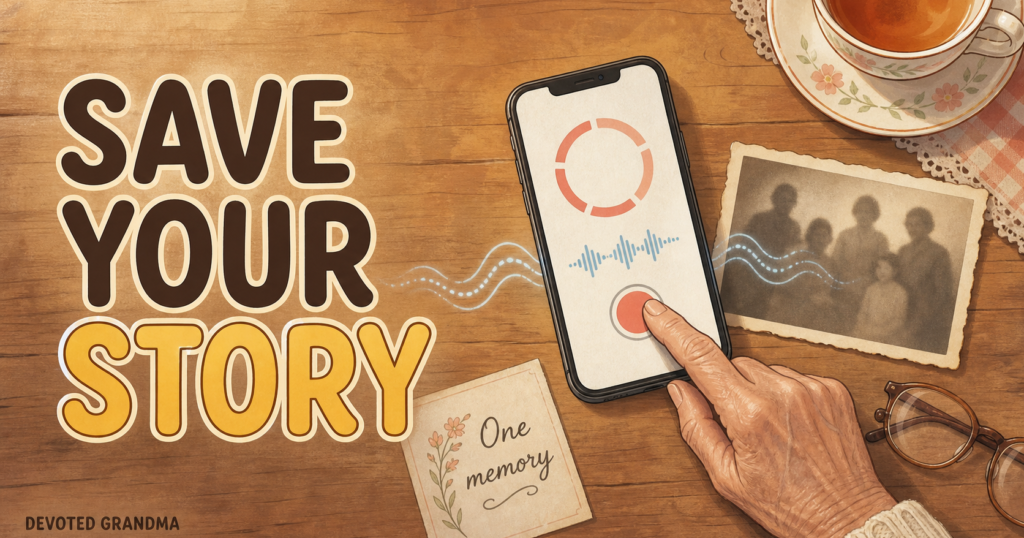
Most smartphones include a basic voice-recording app. Open it, place the phone on a steady surface a comfortable distance away, and choose a quiet room. Turn off the television and silence notifications if you can.
Take one easy breath, press record, and speak as though one grandchild were sitting across the kitchen table. A natural pause or small laugh belongs in the keepsake. If you lose your place, pause and begin that sentence again. Perfection is not the goal; being understandable and recognizably yourself is.
Listen once before saving or sharing. Check that your voice can be heard and that no private information slipped in accidentally. Give the file a useful name, such as “Grandma—Peach Orchard Memory—2026.”
If Recording Is Difficult
If holding or operating a phone is hard, ask a trusted person to press the buttons while you remain in control of what is recorded and shared. You could also use a computer, record in several shorter sections, dictate the story for someone to type, or write it in a card.
A grandchild can interview you by phone and—with everyone’s permission—save the conversation. The important thing is the truthful memory, not the technology.
8. Share It Without Asking for a Performance
Send the recording as a gift, not a test of affection. A grandchild may listen immediately, save it for later, or forget to reply even when the story matters to them.
A gentle note is enough: “I recorded a short family memory for you to keep. There is no need to answer or listen right away.”
This gives the keepsake room to become meaningful in its own time. Grandchildren do not always express what they value, but they often remember the feelings Grandma brings. That quiet truth is explored in the things grandkids value about having Grandma around.
Your Five-Minute Keepsake Checklist
- Choose one small, true memory.
- Mark any uncertain details honestly.
- Plan a beginning, middle, and end.
- Add three genuine sensory details.
- Remove anything that violates another person’s privacy.
- Record in a quiet place and listen once.
- Name the file clearly and save a backup if possible.
- Share it without requiring a response.
You do not have to preserve everything today. Start with one kitchen, one journey, one celebration, one act of kindness, or one afternoon that still lives brightly in your mind.
Five minutes may feel small. But it can hold a voice, a place, a person, and a piece of family history that your grandchild can hear again.